
Vrisha Rongala
Chief Growth Officer

A board that brings the right blend of knowledge and engagement is one of the greatest assets a CEO can have. When directors provide “effective support,” companies deliver stronger shareholder returns, achieve growth goals more consistently, and report higher CEO satisfaction. When that support is missing, momentum falters, leaving leaders without the backing they need.
Recent research reveals the uneven nature of this support. In a Spencer Stuart survey, 43% of directors believed they were providing effective guidance in today’s turbulent environment, while only 22% of CEOs agreed. Fewer than one in four CEOs feel their boards are giving them the strategic thought partnership and expertise needed to respond confidently to disruption.
This disconnect isn’t about intent. Directors generally believe they are leaning in, but CEOs expect more, including strategic thought partnership, specific subject-matter expertise, and deeper knowledge of the company’s challenges and opportunities. The gap between perception and reality leaves critical value on the table.
Seven in ten CEOs who had explicit conversations with their boards about the “type of support and input they could expect” said they felt effectively supported compared with just half of those who did not.
Closing the Confidence Gap: Why the Board-CEO Relationship Needs a Reset
So, the takeaway is clear: CEO-board alignment doesn’t happen by default; it must be intentionally built, tested, and maintained.
In this article, we’ll explore six strategies that help CEOs build better relationships with their boards, practices that turn governance into partnership and challenge into resilience.
6 Strategies to Strengthen CEO-Board Relationship
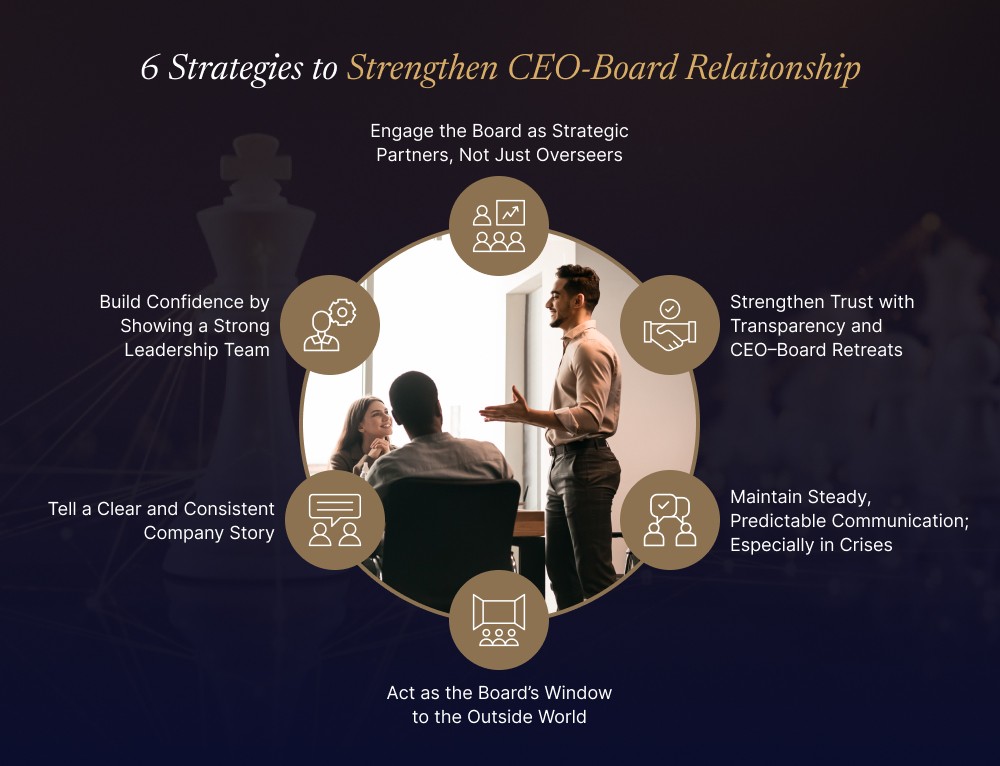
Engage the Board as Strategic Partners, Not Just Overseers
Boards today are dealing with a level of complexity that would have been unthinkable a decade ago. Conversations on topics such as generative AI, cybersecurity, or the net-zero transition now sit alongside traditional oversight responsibilities. Directors are expected to guide strategy while also making sense of an environment defined by rapid change.
This shift makes collaboration between CEOs and boards more essential than ever. In McKinsey’s research on board effectiveness, 59% of directors said they are strengthening collaboration with management teams as their primary tactic for handling complexity. Yet despite this recognition, only one-third of directors and executives believe their boards and CEOs collaborate very effectively. The gap is clear: most leadership teams still have room to elevate the relationship from formal oversight to true partnership.
When CEOs treat the board as a strategic partner, both sides benefit. Directors gain a sharper context on the competitive landscape, stakeholder expectations, and external forces shaping the company. CEOs, in turn, receive valuable perspective, build stronger trust, and create clarity around where management leads and where the board contributes. This alignment frees boards to focus on long-term strategic issues rather than being mired in operational detail.
So how can CEOs put this into practice? Here are several levers, and each requires deliberate CEO action:
Shape the Board Agenda: Work with the chair to design meetings that emphasize strategy, not just operational reporting. This ensures time is spent where it matters most.
Broaden the Lens: Bring in customers, regulators, or subject-matter experts to provide external context that the board can’t get from internal reports alone.
Realign Roles Regularly: Initiate an annual conversation with the board about boundaries and responsibilities. This reduces friction and prevents directors from sliding into operational detail.
Invest in Director On-Boarding: Personally engage with new board members during their orientation. This accelerates trust and helps them contribute meaningfully from the start.
Support Self-Evaluation: Encourage the board to use formal evaluations, and be open to feedback yourself. This signals partnership and a shared commitment to improvement.
The impact of getting this right is substantial. The same McKinsey research shows that boards with effective collaboration are twice as likely to have a high impact on long-term value creation. For CEOs, the takeaway is simple: positioning the board as a partner builds allies in the toughest moments, not overseers waiting to second-guess decisions.
Strengthen Trust with Transparency and CEO–Board Retreats
Transparency is where trust starts. Boards expect CEOs to be direct about performance, purpose, and direction, especially when the path isn’t clear.
As Mike Lipps of Medallia put it:

“By having incredibly transparent foundations, including about why we exist and what we do, our leadership team is able to move forward with the assurance that everyone is on the same page.”
Chairman of the Board, Medallia
That expectation has only intensified as boards become more diverse. Broader perspectives raise decision quality, but they also bring a wider range of questions, communication styles, and priorities. For CEOs, the job is not just to share information, but to make sure every director is working from the same context. Transparency without structure still leaves gaps, and gaps become mistrust.
Spencer Stuart’s annual study of board diversity found that 47% of new S&P 500 directors are from historically underrepresented racial and ethnic groups, and 43% are women. One-third of all new independent directors are Black/African American, three times more than in 2020.
One of the most effective ways to close those gaps is a CEO–board retreat. Unlike routine meetings, retreats create room for deeper conversations about direction, culture, and leadership. Done well, they pull people out of quarterly pressure and into the real issues: what matters most, where the risks are, and how leadership intends to execute. Done poorly, they become polished offsites that produce slides, not alignment.
The best retreats start with a diagnostic, short surveys, interviews, or pulse checks that surface what directors and executives are actually worried about. That preparation keeps the agenda grounded in reality. It also gives CEOs a chance to see leadership dynamics in real time: the quality of debate, the strength of the bench, and whether the team is ready for what’s coming.
The same principle applies outside formal board settings too. When leaders step away from day-to-day noise and get protected time together, the quality of dialogue changes.
The next Imperium Executive Retreat, “Leading the Change: Foresight for a Shifting World,” takes place in Mallorca, Spain (May 20–24, 2026). It is a curated circle of 25 senior leaders designed as a small-group, high-trust environment for clear thinking and peer-level dialogue. Leaders leave with sharper judgment and relationships that carry back into the boardroom and beyond.
Ultimately, CEO–board retreats are not about producing another set of tactical plans. They are about building confidence. When expectations are built into the design, retreats reduce information gaps, surface hard truths, and give directors confidence in both the CEO and the broader leadership team. The result is stronger alignment, deeper trust, and a working relationship that holds under pressure.
Maintain Steady, Predictable Communication; Especially in Crises
Boards can live with disappointing results, but they cannot live with surprises. Nothing erodes trust faster than hearing about a setback from the media or discovering a problem too late.
Crises are inevitable. From regulatory scrutiny to market shocks, disruption will test every leadership team.
A PwC survey of 1,812 business leaders found that 96% had experienced disruption in the past two years, and 76% said it had a medium to high impact on operations.
In those moments, silence or irregular updates create doubt and force directors to fill the gaps themselves. A CEO who maintains steady communication reassures the board that leadership is in control, even when outcomes are uncertain.
The most effective approach is to establish a structured rhythm of touchpoints with the board. This includes regular updates between meetings, clear briefings before decisions, and immediate transparency when risks arise.
In times of crisis, this discipline becomes a lifeline: it prevents rumors, reduces anxiety, and ensures directors are aligned on both the facts and the path forward.
Some of the strongest communication in a crisis is candid, direct, and even vulnerable. Boards want to know what the CEO knows, when they know it, and how leadership is responding. Reliability in these moments strengthens credibility and deepens the relationship long after the crisis has passed.
Act as the Board’s Window to the Outside World
Directors bring governance expertise, but they are rarely as close to customers, employees, markets, or public sentiment as the CEO. That makes the CEO’s role as interpreter of the outside world essential for building stronger relationships with the board.
Boards already track global issues such as regulation, geopolitics, or industry shifts, but what they value most is context. CEOs who can filter the noise and explain how external forces affect the company’s risks, opportunities, and long-term positioning give boards confidence that management is in control. Just as important is judgment: strong CEOs know when to engage on an issue and when silence better serves the company’s values and reputation.
Bringing this perspective requires discipline. The best CEOs combine insights from frontline employees, customers, investors, and competitors into board discussions so directors understand the business environment beyond financial results.
McKinsey research shows that organizations that actively listen and act on recommendations from frontline employees are 80% more likely to consistently implement new and better ways of working.
For boards, this kind of bottom-up intelligence, coupled with market and industry signals, creates a holistic view of the company’s environment that directors cannot get elsewhere.
Digital platforms add another dimension. Social media is not about CEOs becoming influencers; it is a powerful tool for monitoring competitor messaging, investor sentiment, and stakeholder expectations in real time.
According to a Weber Shandwick report, 76% of executives believe it’s a good idea for CEOs to have a social media presence, 73% regularly check their CEO’s posts, and 69% wish their CEOs posted more frequently.
CEOs who deliberately decide how to use (or not use) social media, while monitoring it for signals, can equip boards with timely insights that shape both strategy and trust.
The CEOs who excel at this don’t overwhelm directors with data dumps. They curate. They build it into pre-reads, weave it into boardroom discussions, and share informal updates when needed. This practice reassures boards that leadership is tuned to the external world and is guiding the company with foresight, not reaction.
Ultimately, acting as the board’s window to the outside world deepens trust. It positions the CEO not only as an operator, but as the board’s strategic ally, the one who ensures directors have the clarity they need to govern effectively and prepare the organization for what lies ahead.
Tell a Clear and Consistent Company Story
Data, financials, and strategy decks are necessary, but they don't create alignment on their own. Boards and stakeholders alike respond to a narrative that makes sense of where the company has been, where it is headed, and why it matters. A clear and consistent story helps directors see not just the numbers, but the conviction and purpose behind them.
An effective company story often answers four questions: Who, Why, What, and When.
The “Who” begins with the CEO. Directors want to understand the leader's own journey, values, and aspirations because these shape the choices management makes. Personal context turns abstract strategy into something tangible. When CEOs share how their personal experiences connect to the company's priorities, it adds authenticity and demonstrates that strategic decisions are rooted in conviction rather than just analysis.
The “Why” reinforces the organization's broader mission. Companies with a clearly defined purpose consistently outperform peers, in part because they can mobilize people around something bigger than quarterly earnings. For boards, hearing the "why" reassures them that strategy is rooted in long-term relevance. The strongest CEOs also understand the motivations of external stakeholders, investors, regulators, and even the media, and weave those into their narrative. When directors see that alignment, they gain confidence that leadership is anticipating financial outcomes as well as meeting reputational and societal expectations too.
Once the Who and Why are established, the What and When bring the narrative into action.
The “What” is the substance of the strategy, the company’s core priorities and ambitions. The most effective CEOs distill their agenda into simple language or a unifying message that cuts through complexity. This makes it easier for directors, employees, and external stakeholders alike to rally around the same ambition.
The “When” is about timing and sequencing. Directors want to know what the priorities are and when they will be acted on. Laying out milestones, phasing initiatives in the right order, and choosing the best moments to communicate each step all matter. Done well, this reassures boards that ambition is matched by execution discipline, addressing today’s needs while signaling readiness for future moves.
Consistency across channels is what makes the story stick. CEOs who use the same themes in board meetings, investor calls, and employee messages reinforce alignment and avoid fragmentation. Yet consistency does not mean rigidity. The most trusted leaders know how to hold firm on purpose while adapting language and emphasis as circumstances change. This balance convinces directors that the CEO is both principled and pragmatic.
Ultimately, a compelling business storytelling skill is more than messaging; it is a leadership tool that shapes how boards engage with management. When directors hear a narrative that connects personal conviction, organizational purpose, and strategic clarity, they function as true partners in the journey ahead.
Build Confidence by Showing a Strong Leadership Team
Boards evaluate not just the CEO but the strength of the leadership team as a whole. A chief executive who is the only visible voice may raise concerns about the concentration of responsibility. In contrast, CEOs who cultivate a group of senior leaders who can speak with confidence about the company’s vision and priorities signal depth, resilience, and continuity.
Building this capability doesn’t happen on its own. Communication is a discipline that requires practice and development. Companies that regularly succeed in influencing industry debates and protecting their reputation are far more likely to invest in leadership excellence programs for their top executives to engage externally. When CFOs, COOs, and other leaders can translate strategy into compelling stories grounded in data, execution, or purpose, they become trusted ambassadors who extend the CEO’s influence.
Hearing aligned voices across the leadership team demonstrates that direction is consistent and not dependent on a single individual. It also exposes directors to multiple perspectives, enriching oversight. A CEO may focus on vision and purpose, while other leaders highlight operational execution or stakeholder priorities. Together, they present a fuller, more credible picture.
Effective CEOs embed this approach into the culture. They involve their senior teams in shaping the company’s narrative, encourage collaboration, and create ownership of the message. As leaders repeat and cascade these stories through their own functions, consistency builds naturally across the organization and into external conversations. The ripple effect often extends beyond the company itself, with customers, partners, and alumni amplifying the message through their own networks.
Conclusion
You can’t build a strong CEO–board relationship on quarterly meetings alone. The trust that holds in a crisis is built earlier, through clarity, consistency, and honest dialogue when the stakes are still manageable.
The most effective CEOs treat alignment as a leadership discipline. They shape the agenda toward strategy, remove surprises through predictable communication, bring real outside context into the room, and build board confidence by showing a leadership team that can carry the narrative together.
When alignment needs a reset, distance helps. Stepping away from the quarter creates space for the conversations that are usually postponed: what’s really changing, where the board is uneasy, and what decisions require shared conviction. Imperium retreats are built for that, a small-circle setting designed for clear thinking, direct peer exchange, and decisions that hold once you’re back in the room.
To explore upcoming Imperium retreats or discuss a tailored leadership experience for your organization, reach out to the Imperium team. We’ll respond with details and next steps.
FAQs
1. Why is the CEO–board relationship so important?
Accordion content
2. What do CEOs expect from their boards?
Accordion content
3. Why do boards and CEOs often disagree about support?
Accordion content
4. How can CEOs build trust with their boards?
Accordion content
5. What role does communication play in the CEO–board relationship?
Accordion content
6. How can CEOs engage boards as strategic partners?
Accordion content
7. How can CEOs act as a board’s “window to the outside world”?
Accordion content
8. Why should CEOs showcase their leadership team to the board?
Accordion content
9. What practical steps improve CEO–board alignment?
Accordion content
10. How can leadership development strengthen CEO–board relationships?
Accordion content
Vrisha Rongala
Ms. Vrisha Rongala is the Chief Growth Officer at Edstellar, where she leads brand and growth strategy. She began her career at JWT and Saatchi & Saatchi, working on campaigns for global brands including Infosys and Microsoft. At Edstellar, she has shaped the company’s identity and strengthened its enterprise presence as a one-stop talent development partner. She now leads Imperium, an executive strategy retreat for CEOs and founders focused on clear thinking and peer-level dialogue.
Search
Popular Posts
Related Post

Vrisha Rongala
/
Chief Growth Officer
Executive Resilience
Feb 25, 2026

Vrisha Rongala
/
Chief Growth Officer
Executive Resilience
Feb 20, 2026

Vrisha Rongala
/
Chief Growth Officer
Leadership Development
Feb 18, 2026