
Vrisha Rongala
Chief Growth Officer

The CEO role in 2026 continues to grow more demanding as leaders balance rapid technological change, investor expectations, workforce transformation, and economic uncertainty. Decisions made at the executive level often carry long-term consequences for employees, markets, and stakeholders.
Despite leading large organizations, many CEOs operate in relative isolation. Internal teams expect clarity and confidence, boards demand strategic direction, and investors seek consistent performance. Yet opportunities for candid, consequence-free dialogue are rare at the top.
To address this challenge, many executives participate in CEO peer advisory groups and confidential communities where leaders exchange experience, test strategic thinking, and gain perspective from peers navigating similar challenges.
Rather than theoretical discussions, these groups provide practical leadership insight grounded in real business outcomes. Participation often strengthens executive decision-making while reducing leadership isolation.
This article highlights the Top 10 CEO Peer Advisory Groups in 2026, focusing on networks that consistently provide strategic and leadership value for senior executives worldwide.
Why CEO Peer Advisory Groups Matter Today
Modern business challenges rarely come with predictable solutions. CEOs regularly face complex decisions involving acquisitions, restructuring, international expansion, talent transitions, and digital transformation.
Consultants and internal advisors provide analysis, but peer advisory groups offer real-world experience. Leaders gain insights from executives who have personally navigated similar challenges and can share lessons learned from actual outcomes, often helping reduce pressures associated with CEO decision fatigue when making high-impact choices.
These groups also create confidential environments where CEOs can openly discuss concerns without affecting organizational confidence. Such candid discussions often help leaders avoid costly strategic mistakes while strengthening long-term leadership resilience.

“CEOs today must balance short-term performance with long-term resilience.Structured peer dialogue helps leaders benchmark governance practices and anticipate systemic risk.”
President & CEO/The Conference Board
Top 10 CEO Peer Advisory Groups in 2026
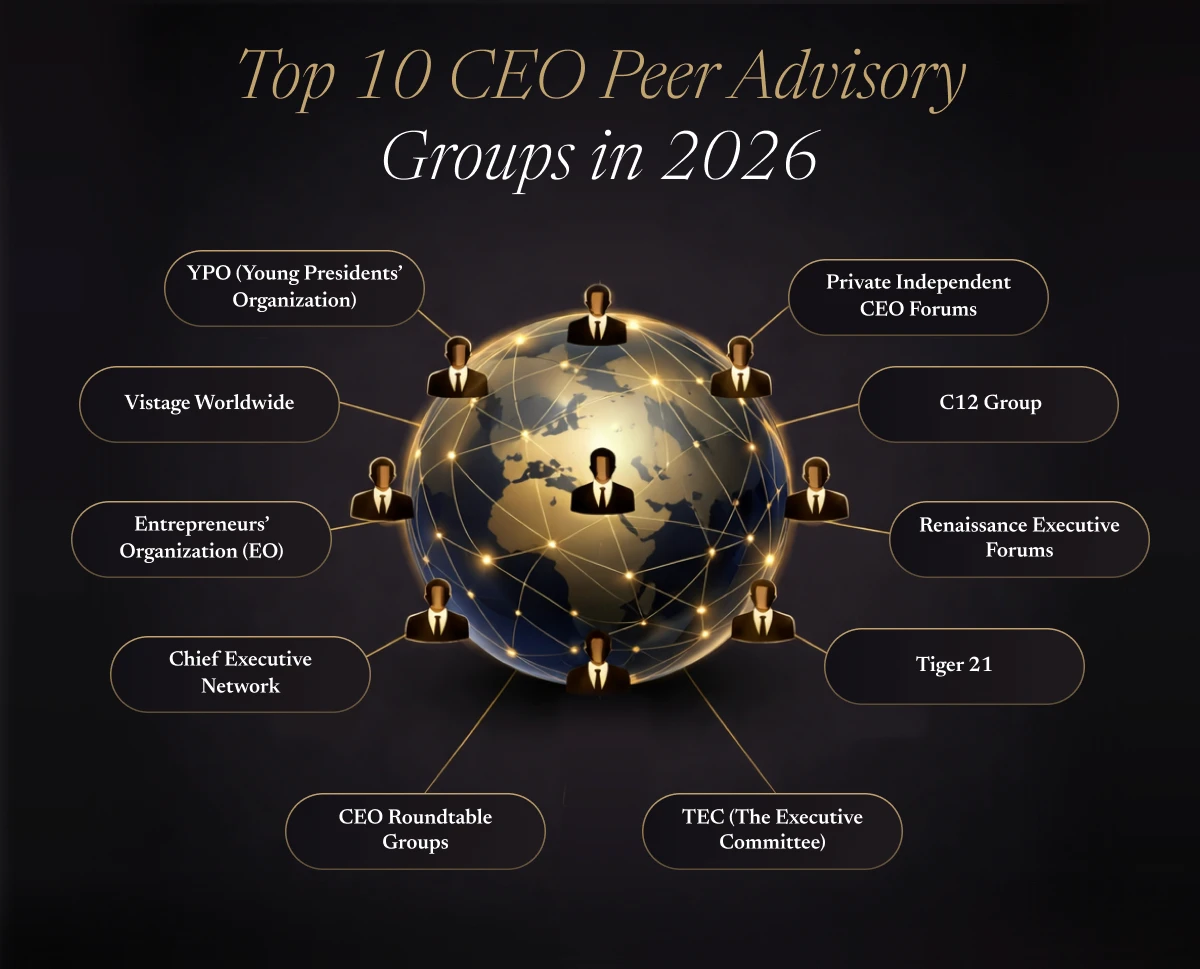
1. YPO (Young Presidents’ Organization)
YPO remains one of the world’s most influential CEO peer networks, operating in over 150 countries and bringing together leaders of major enterprises across industries.
At the core of YPO’s experience are confidential forums where small groups of executives meet regularly to discuss both professional and personal leadership challenges. These forums foster long-term advisory relationships built on trust.
Members also gain access to global leadership programs and international summits that provide exposure to global markets, new partnerships, and emerging leadership practices.
Strengths
• Highly selective global membership
• Deep peer forum relationships
• Leadership education programs
• International networking opportunities
Best suited for
CEOs leading rapidly expanding enterprises seeking global peer exposure and long-term leadership development.
2. Vistage Worldwide
Vistage combines CEO peer advisory groups with professional executive coaching, making it one of the most structured leadership support systems worldwide.
Monthly sessions allow executives to present challenges, receive peer feedback, and access leadership development insights. Many sessions include expert speakers and performance benchmarking discussions.
Vistage groups often become trusted advisory boards for CEOs navigating operational scaling, organizational restructuring, and leadership transitions.
Strengths
• Professional facilitation and coaching integration
• Structured advisory meetings
• Leadership development resources
• Performance benchmarking support
Best suited for
Mid-market CEOs seeking structured operational and leadership guidance.
3. Entrepreneurs’ Organization (EO)
EO supports founders and entrepreneurs leading high-growth businesses, many of whom now operate large multinational enterprises.
Peer forums encourage strong relationships where members discuss both business and personal leadership journeys. EO’s global events and regional chapters foster collaboration and shared learning.
EO plays a significant role for founders transitioning from entrepreneurial management styles to institutional leadership structures.
Strengths
• Founder-centered leadership community
• Global networking opportunities
• Strong peer support structures
Best suited for
Founder-led companies transitioning into mature enterprises.
4. Chief Executive Network
This invitation-only network connects CEOs through industry-focused councils that address governance challenges, economic outlooks, and corporate strategy shifts.
Members gain insight from discussions involving regulatory changes, competitive pressures, and board-level governance concerns. The network is particularly influential among leaders managing complex industries.
Strengths
• Industry-specific executive councils
• Governance and policy insights
• High-caliber executive membership
Best suited for
CEOs navigating regulatory, policy, or governance complexity.
5. CEO Roundtable Groups
CEO roundtables consist of smaller advisory circles focused on confidential leadership discussions and collaborative decision-making.
Because these groups are typically small, members often develop strong trust, enabling deeper conversations about strategic challenges, leadership dilemmas, and organizational transitions.
Strengths
• Confidential advisory environments
• Personalized peer discussions
• Long-term advisory relationships
Best suited for
CEOs seek intimate advisory environments rather than large global networks.
6. TEC (The Executive Committee)
TEC focuses on leadership development through peer advisory participation supported by executive coaching. Members often include business owners transforming founder-led companies into professionally managed enterprises.
Sessions frequently address organizational scaling challenges, leadership capability building, governance structures, and operational discipline.
TEC environments often become transition support systems for CEOs navigating rapid company growth.
Strengths
• Coaching-supported advisory participation
• Leadership development programs
• Execution accountability support
Best suited for
CEOs scaling growing companies into structured institutional organizations.
7. Tiger 21
Tiger 21 serves ultra-high-net-worth entrepreneurs and CEOs managing significant wealth following liquidity events or business exits.
Discussions typically revolve around capital allocation strategies, wealth preservation, investment diversification, and leadership transitions after stepping away from operating roles.
Members often share insights into managing family offices, investment portfolios, and philanthropic initiatives.
Strengths
• Investment and wealth strategy exchange
• Confidential peer capital discussions
• Support for post-exit leadership transitions
Best suited for
CEOs transitioning into investor, board, or portfolio leadership roles.
8. Renaissance Executive Forums
Renaissance Executive Forums provide structured peer advisory boards emphasizing leadership accountability and collaborative strategic decision-making.
Membership diversity across industries allows leaders to gain insights beyond their immediate sectors, often revealing alternative approaches to growth, operations, and talent management.
Forums also emphasize execution accountability, ensuring leaders follow through on commitments discussed during sessions.
Strengths
• Cross-industry peer engagement
• Leadership accountability structures
• Collaborative advisory format
Best suited for
Senior executives seeking a strategic perspective beyond their own industry.
9. C12 Group
C12 integrates faith-based leadership principles into executive advisory discussions, helping leaders align strategic decisions with ethical frameworks and personal values.
Meetings typically include discussions around business challenges, leadership responsibility, and organizational stewardship from a values-centered perspective.
This structure attracts executives seeking alignment between personal belief systems and corporate leadership decisions.
Strengths
• Values-centered leadership discussions
• Ethical decision frameworks
• Business and personal leadership guidance
Best suited for
Executives seeking values-aligned peer advisory communities.
10. Private Independent CEO Forums
Boutique advisory firms increasingly host invitation-only CEO forums tailored to select leadership circles.
These forums often address high-impact topics such as succession readiness, governance transitions, mergers and acquisitions, investor relationships, and cross-border expansion strategies.
Because participation is typically limited, discussions are highly personalized and often reflect the immediate strategic concerns of participating executives.
Strengths
• Customized advisory experiences
• Succession and governance discussions
• Cross-border expansion insights
Best suited for
Senior leaders seeking personalized advisory engagement with trusted peer groups.
How CEOs Choose the Right Peer Advisory Group
Selecting the right peer advisory group depends on how well the network aligns with a CEO’s leadership needs and company stage. Executives typically look for environments where discussions remain relevant, confidential, and practically useful rather than functioning as general networking forums.
In practice, CEOs evaluate several important factors before committing to a group:
• Members lead businesses of similar scale or complexity
• Discussions are confidential and allow sensitive topics to be shared safely
• Meeting format suits leadership preference, whether structured or peer-led
• Industry diversity offers fresh perspectives or sector-specific insight
• Participation expectations fit executive schedules
• Groups provide long-term advisory value beyond networking opportunities
The right advisory group often evolves into a trusted external sounding board, supporting leaders through different business cycles, leadership transitions, and strategic inflection points.
Benefits of CEO Peer Advisory Groups
Leaders who actively participate in peer advisory groups often experience measurable improvements in leadership effectiveness and strategic clarity, helping reduce long-term pressures linked to burnout risks among CEOs. Exposure to real executive experiences helps CEOs approach complex decisions with greater confidence and reduced uncertainty.
Common leadership outcomes from advisory participation include:
• Faster and more confident strategic decision-making
• Reduced leadership isolation at the executive level
• Exposure to cross-industry leadership perspectives
• Accountability support for executing strategic decisions
• Better readiness for crisis and change management situations
• Improved governance and leadership succession preparedness
• Stronger leadership resilience over time
As trust and relationships deepen within advisory groups, many executives begin to view these forums not simply as discussion platforms but as long-term leadership support systems that strengthen decision-making across multiple stages of business growth.
Conclusion
In 2026, effective CEOs understand that leadership success rarely comes from operating in isolation. Business environments are too complex and decisions too interconnected for leaders to rely only on internal perspectives.
CEO peer advisory groups create confidential spaces where executives gain clarity, challenge assumptions, and learn from leaders who have faced similar strategic pressures. This support helps CEOs make stronger decisions and maintain focus during uncertain periods.
Many leaders further strengthen their effectiveness through curated environments such as CEO retreats, where strategic reflection and peer relationships deepen beyond formal advisory sessions, helping executives sustain long-term leadership success.
FAQs
What is a CEO peer advisory group?
Accordion content
Who should join a CEO peer advisory group?
Accordion content
How do peer advisory groups improve decisions?
Accordion content
Are advisory groups only for large enterprises?
Accordion content
How often do groups meet?
Accordion content
Are discussions confidential?
Accordion content
How are advisory groups different from coaching?
Accordion content
Do groups help with succession planning?
Accordion content
How long do CEOs stay in advisory groups?
Accordion content
Are advisory groups mainly networking platforms?
Accordion content
Vrisha Rongala
Ms. Vrisha Rongala is the Chief Growth Officer at Edstellar, where she leads brand and growth strategy. She began her career at JWT and Saatchi & Saatchi, working on campaigns for global brands including Infosys and Microsoft. At Edstellar, she has shaped the company’s identity and strengthened its enterprise presence as a one-stop talent development partner. She now leads Imperium, an executive strategy retreat for CEOs and founders focused on clear thinking and peer-level dialogue.
Search
Popular Posts
Related Post

Vrisha Rongala
/
Chief Growth Officer
Executive Resilience
Feb 25, 2026

Vrisha Rongala
/
Chief Growth Officer
Executive Resilience
Feb 20, 2026

Vrisha Rongala
/
Chief Growth Officer
Leadership Development
Feb 16, 2026