
Vrisha Rongala
Chief Growth Officer

The CEO role is a decision factory. Not because you enjoy choosing, but because uncertainty keeps landing on your desk: pricing, people, capital, risk, narrative. Some calls are existential. Many are small. All draw from the same mental budget.
Decision fatigue is what happens when that budget gets depleted. Not burnout. Not stress. A measurable drop in judgment: slower calls, more second-guessing, more defaulting to “safe,” and fewer bold moves when timing matters.
Left unattended, it becomes an execution tax on the entire company.
This article breaks down what decision fatigue looks like at the CEO level, why the role is uniquely exposed, the business costs of delayed or distorted decisions, and the operating-system fixes that restore clarity, speed, and resilience.
What is Decision Fatigue?
Decision fatigue is what happens when the sheer act of making choice after choice drains your mental energy. First studied by psychologists Roy Baumeister and Kathleen Vohs, it’s the point where each additional decision feels harder, and the quality of judgment starts to slip.
Neuroscience supports this finding: the prefrontal cortex, the part of the brain responsible for focus and self-control, functions less efficiently after sustained decision-making. The result? Leaders are more likely to delay, avoid, or rush critical calls.
For CEOs, this isn’t an abstract concept. From strategy and investor relations to hiring and crisis management, the decisions never stop. By the time the toughest choices land on your desk, your mental reserves may already be depleted. And that’s when clarity gives way to hesitation, safe bets, or costly mistakes.
The Leadership Risks of Decision Fatigue
McKinsey finds that executives spend nearly 40% of their time making decisions, and most admit that time is poorly used. For a CEO, that wasted energy isn’t a minor inefficiency; it’s a drag on strategy. Every unclear or delayed choice eats into growth, investor confidence, and competitive positioning.
The scale of the problem is hard to ignore. 85% of business leaders report “decision distress,” regretting or second-guessing calls they’ve made. A Peak report adds to the picture: nearly two-thirds of C-suite executives (64%) say decisions are more complex than ever, half (49%) admit critical calls take too long, and more than half (54%) confess they’ve regretted a major decision made under pressure.
Those numbers translate into serious business risk. A delayed call can mean missing the right acquisition window. An impulsive move can rattle markets. A pattern of hesitation erodes trust with boards and investors, while overcorrection can fracture employee confidence. In an environment where competitors move fast, decision fatigue becomes an invisible tax on execution.
Left unchecked, it doesn’t just slow down leaders; it slows down organizations
Why CEOs are Especially Prone to Decision Fatigue?
Decision fatigue is amplified at the CEO level. Unlike task-focused roles, the CEO’s world is a constant mix of high-stakes judgments, ambiguity, and relentless demands. The result is a cognitive load that makes leaders far more vulnerable to fatigue and erosion of clarity.
What’s more?
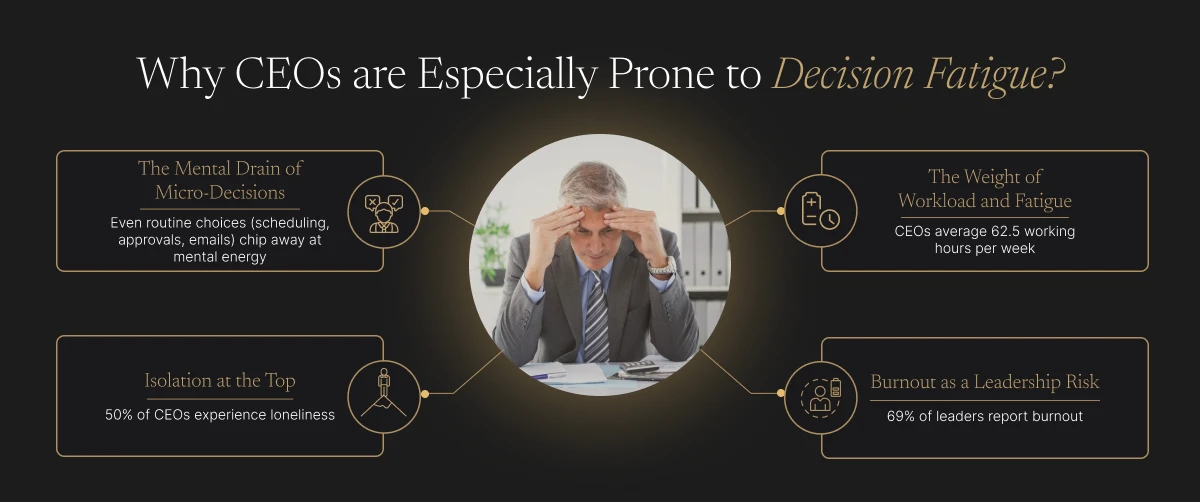
The Mental Drain of Micro-Decisions
It isn’t only the big calls that consume energy. The accumulation of smaller choices from scheduling meetings to approving requests steadily chips away at mental reserves. Left unmanaged, these “micro-decisions” eat into the focus that should be reserved for strategic judgment.
Barack Obama famously addressed this by limiting trivial decisions. In a Vanity Fair interview, he explained why he stuck to blue or gray suits:

“I don’t want to make decisions about what I’m eating or wearing. Because I have too many other decisions to make.”
Former US President
The lesson for leaders is clear: even everyday decisions erode the clarity needed for the calls that truly shape organizations.
Isolation at the Top
For many CEOs, the job comes with a deep sense of isolation. Research cited by Forbes shows that half of CEOs experience loneliness, and 61% say it hampers performance. Nearly 70% of first-time CEOs feel this isolation undermines their effectiveness. Beyond morale, CEO isolation weakens judgment, slows decision velocity, and leaves leaders without the sounding boards they need most.
The Weight of the Workload and Fatigue
CEOs average 62.5 working hours per week, with days stretching across strategy sessions, investor calls, and board demands. Add frequent travel and near-constant digital engagement, and the real challenge isn’t just the hours, but sustaining clarity over time. Sleep patterns compound the issue: CEOs average 6.7 hours a night, compared to 8.75 for most professionals. That deficit steadily erodes decision quality.
Burnout as a Leadership Risk
Burnout is no longer abstract at the top. According to Zipdo insights, nearly 69% of leaders report experiencing it, often leading to disconnection (45%) or heightened turnover risk (30%). Only three in ten senior executives feel they can sustain their responsibilities without burning out.
Add financial pressures (63%) and people-management strain (68%), and CEOs find themselves operating in a near-constant state of mental edge.
The Business Impact of CEO Decision Fatigue
Decision fatigue doesn't just affect the individual leader; it cascades across the entire organization, slowing execution, weakening competitiveness, and eroding trust.
Productivity Losses That Cascade
When CEOs hesitate or second-guess, teams mirror that uncertainty. Execution slows, alignment weakens, and disengagement spreads. Gallup estimates that disengaged employees cost U.S. businesses up to $605 billion annually, and it often starts at the top, when leadership clarity falters.
Innovation on Hold
Fatigued leaders default to caution. High-potential projects get sidelined, product cycles drag, and bold market bets shrink into incremental improvements. In fast-moving industries, that hesitation can mean missing the window for growth.
Crisis Decisions Under Pressure
Leadership strain magnifies risk when the stakes are highest. History shows us from financial emergencies to global crises that decision fatigue doesn't just impair choices, it accelerates failure.
During the COVID-19 pandemic, Boris Johnson's leadership was marked by hesitation and abrupt shifts in direction. As Lee Cain, the then-director of communications, testified in the UK COVID inquiry, "erratic decision-making" left aides "exhausted", undermining timely crisis response.
This shows that in moments requiring clarity and resolve, cognitive fatigue is far more than a health warning; it's a crisis multiplier. Decisions delayed or reversed under strain don't just reflect personal exhaustion; they can destabilize governments, organizations, and outcomes.
The Financial Drag of Burnout
Deloitte estimates poor mental health costs the UK financial sector more than £5,000 per employee each year, with global losses from anxiety and depression topping $1 trillion annually. For CEOs, the numbers translate differently: investor confidence dips, attrition costs climb, and shareholder value erodes when leadership clarity slips.
Eroded Trust and Slower Growth
Burnout makes leaders more risk-averse, which slows decision speed and dampens organizational agility. Boards grow uneasy, investors sense hesitation, and employees lose confidence in the direction of leadership. Over time, this compounds into lost market share and weaker resilience.
A Case for Restored Leadership Clarity
The turnaround at Microsoft under Satya Nadella illustrates the opposite. By reshaping decision processes and culture around clarity, empathy, and a growth mindset, Nadella freed up leadership bandwidth. This gave Microsoft space to pursue bold cloud strategies, rebuild investor confidence, and reignite innovation. It shows that when CEOs restore focus and decision capacity, entire organizations can pivot from stagnation to growth.
Unmanaged fatigue is a hidden tax on competitiveness, culture, and financial performance. In today's volatile environment, where speed and adaptability define survival, ignoring CEO decision fatigue can mean forfeiting the next wave of growth.
8 Strategies to Overcome Decision Fatigue for CEOs
With the right practices, CEOs can protect their mental clarity, conserve energy for high-stakes calls, and set a standard for decision-making across the organization. Here are eight strategies to overcome decision fatigue in CEOs.
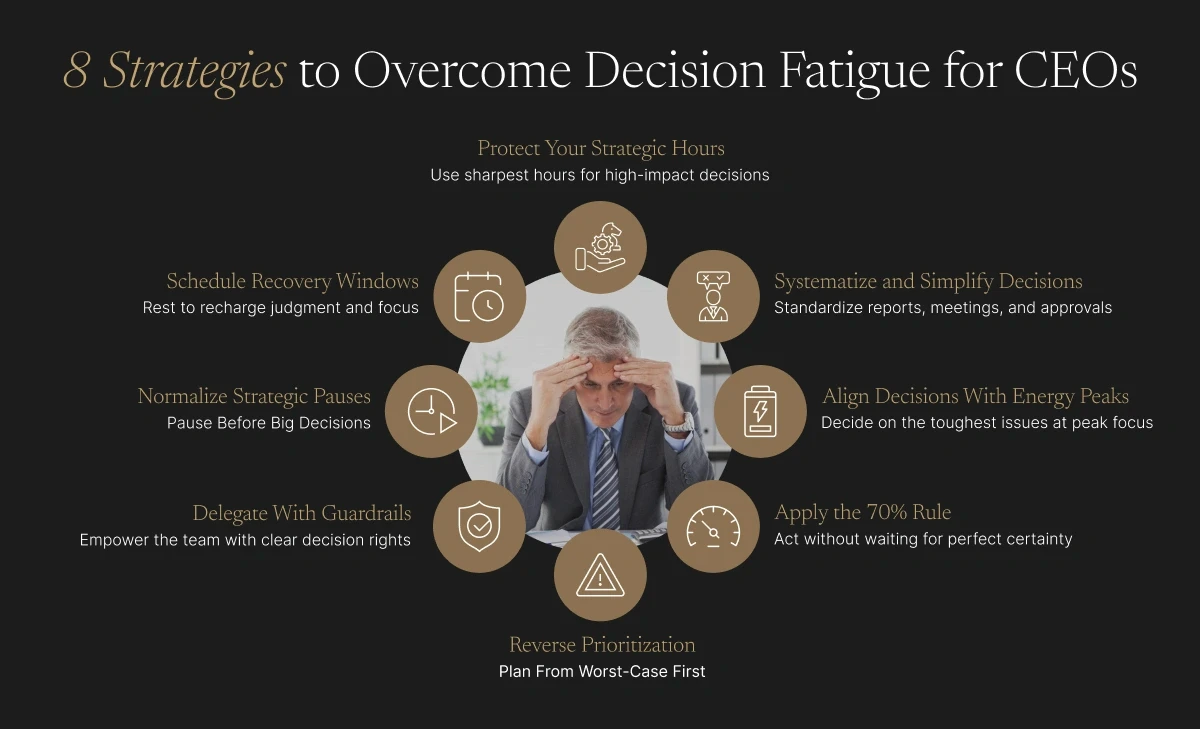
1. Protect Your Strategic Hours
The early hours of the day carry the most cognitive power. CEOs who guard their first 90 minutes for planning, board prep, investor updates, or creative work ensure their sharpest focus goes to the decisions that matter most. Protecting this window establishes rhythm and resilience across the day.
2. Systematize and Simplify Decisions
Repetition and clutter are two of the biggest drains on leadership clarity. CEOs don’t need to revisit how reports are structured, how meetings open, or which approvals require escalation; those should be decided once and codified. Standardizing board reporting, fixing leadership meeting agendas, and using consistent templates cut out low-value choices that silently drain energy. By building these systems, leaders free up bandwidth for the strategic calls that only they can make, while also creating a culture of clarity and consistency across the organization.
3. Align Decisions With Energy Peaks
Mental sharpness fluctuates, and CEOs who align their toughest decisions with natural energy peaks gain a decisive edge. High-stakes discussions like M&A reviews or crisis calls should land during periods of peak focus, while lower-energy hours can be reserved for updates and routine check-ins. Designing your calendar around energy flow directly improves the quality of judgment.
4. Apply the 70% Rule
In uncertain environments, waiting for perfect data often means missed opportunities. Many CEOs adopt the 70% rule moving forward when they are about 70% confident in a decision. Acting on good-enough clarity maintains momentum, and review points allow for course correction. This balance of speed and adaptability keeps organizations agile even in high-risk conditions.
5. Reverse Prioritization
Instead of chasing the best option, start with the worst-case scenario. Identifying what could cause the greatest harm, whether reputational damage, regulatory backlash, or shareholder value destruction, and then working backward, creates clarity. It eliminates noise, accelerates decision-making, and safeguards against blind spots.
6. Delegate With Guardrails
Decision fatigue grows when CEOs hold on to too much. Effective leaders empower their C-suite with clear decision rights and escalation rules. By setting boundaries for which calls are CEO-only and which can be owned by the team, leaders not only preserve their own focus but also strengthen organizational capacity to decide quickly and confidently.
7. Normalize Strategic Pauses
In high-pressure environments, speed is often glorified. The better signal is restraint: clarity matters more than reflex. Build a rule for consequential calls, pause, test assumptions, and return with a decision you can defend. Even a 24-hour buffer before locking a high-stakes move reduces avoidable errors and strengthens board and team confidence.
Sometimes the pause you need isn’t 24 hours. It’s the distance and the right room, before you commit the next major bet.
Imperium’s “Leading the Change” executive retreat is a structured pause for CEOs and founders. In Mallorca (May 20–24, 2026), leaders get structured distance to pressure-test the next set of bets with peers who understand the seat, so decisions improve before they hit the organization.
8. Schedule Recovery Windows
Leadership is an endurance game. Just as athletes build rest into training, CEOs need deliberate recovery to sustain clarity. Short breaks between board sessions, reflection time after investor calls, or even a reset walk before a negotiation prevent mental exhaustion from compounding into poor decisions.
Conclusion
Decision fatigue isn’t a motivation problem. It’s what happens when the role runs on constant judgment without a system to protect attention, reduce noise, and build recovery into the week. Left unchecked, it turns good leaders cautious, slow, and reactive, and the organization feels it in missed windows and diluted execution.
The fix is not working harder. It’s designing decision architecture: fewer low-value choices, clearer decision rights, disciplined pauses before big bets, and recovery that keeps the brain online when it matters most.
And sometimes the fastest reset is distance from the operating tempo and the right room. A curated CEO retreat creates space to step out of reaction mode, pressure-test priorities with peers, and return with clearer decisions you can stand behind.
FAQs
1. What is decision fatigue in CEOs?
Accordion content
2. Why are CEOs more prone to decision fatigue than others?
Accordion content
3. How does decision fatigue impact business performance?
Accordion content
4. What are the signs of decision fatigue in CEOs?
Accordion content
5. Can decision fatigue lead to CEO burnout?
Accordion content
6. What are some proven strategies for CEOs to manage decision fatigue?
Accordion content
7. How does isolation contribute to decision fatigue in CEOs?
Accordion content
8. How does poor sleep affect CEO decision-making?
Accordion content
Vrisha Rongala
Ms. Vrisha Rongala is the Chief Growth Officer at Edstellar, where she leads brand and growth strategy. She began her career at JWT and Saatchi & Saatchi, working on campaigns for global brands including Infosys and Microsoft. At Edstellar, she has shaped the company’s identity and strengthened its enterprise presence as a one-stop talent development partner. She now leads Imperium, an executive strategy retreat for CEOs and founders focused on clear thinking and peer-level dialogue.
Search
Popular Posts
Related Post

Vrisha Rongala
/
Chief Growth Officer
Executive Resilience
Feb 25, 2026
Vrisha Rongala
/
Chief Growth Officer
Executive Resilience
Feb 20, 2026

Vrisha Rongala
/
Chief Growth Officer
Leadership Development
Feb 18, 2026