
Vrisha Rongala
Chief Growth Officer

Leadership carries prestige and power, but it also extracts a price few talk about: CEO Isolation. The higher you rise, the fewer peers you find at your side. Every decision is scrutinized, yet genuine support often feels out of reach.
Brian Chesky, cofounder and CEO of Airbnb, put it bluntly:

“For me, being a founder wasn’t lonely (I had two great co-founders). However, the depths of loneliness I experienced as a CEO are difficult to put into words.”
Co-founder & CEO, Airbnb
He's not alone. RHR International found that half of CEOs report feeling lonely, and 61% believe it undercuts their performance. Deloitte's survey of 2,000 executives went further: nearly three-quarters said their well-being has taken a hit, and many have considered stepping down for healthier roles.
These aren't statistics to glance over. They signal a truth most CEOs know but rarely say aloud: isolation clouds judgment, narrows perspective, and slowly distances leaders from the very teams they're meant to inspire.
The question isn't whether CEO Isolation exists; it's how you confront it before it confronts you.
Let's dive in.
What is CEO Isolation?
CEO Isolation is the experience of being surrounded by people, yet unable to access the unfiltered truth or share the real weight of responsibility. The higher a leader rises, the more challenging it becomes to display vulnerability, receive candid feedback, or admit to doubt without repercussions.
As Francois Lupien, founder of CEO Secret Weapon, puts it:

“Being a CEO can feel like steering a ship through fog. You’re the captain, responsible for every course correction, yet the isolation is often profound. Decisions pile up, the mental load never lets up, and the distance between you and others, even your closest team, quietly widens.”
CEO Secret Weapon
What makes CEO Isolation different from ordinary loneliness is how it changes relationships. People stop speaking freely, feedback gets filtered, and slowly the leader becomes a role to be managed rather than a person to be engaged.
Why CEO Isolation Happens: 5 Root Causes Leaders Must Recognize
According to CJPI data, nearly 72% of CEOs report feeling lonely in their roles, and 41% believe the isolation has worsened since the pandemic. So, why does it persist, even for leaders with strong boards and busy calendars?
The truth is, CEO Isolation isn’t accidental. It grows out of structural pressures built into the role, which, left unchecked, turn isolation into an occupational hazard.
Here are five root causes every leader needs to recognize before they can address them.
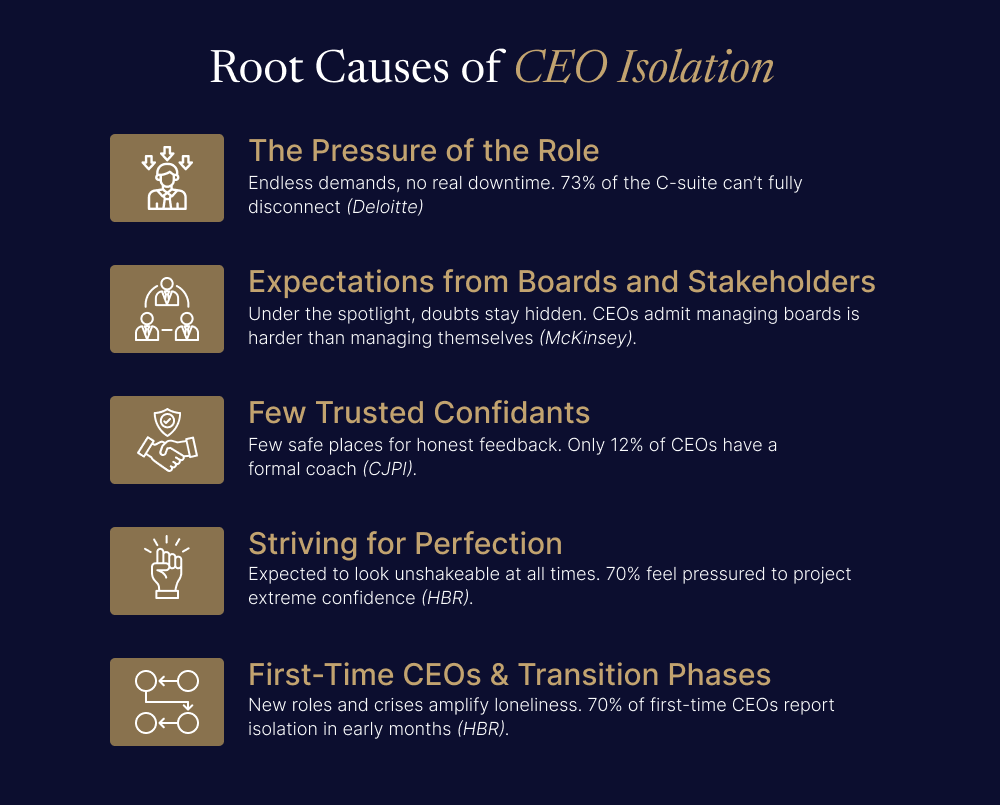
The Pressure of the Role
Every decision a CEO makes, whether reshaping culture, steering growth, or facing a crisis, carries disproportionate weight. The expectation is always to project confidence and clarity, even when the path ahead is uncertain.
That constant demand doesn’t switch off. Deloitte found that 73% of the C-suite admit they cannot take time off or disconnect, as the work simply doesn’t allow it. When even rest becomes impossible, pressure turns relentless. And when doubts must be hidden behind composure, that pressure isolates more than it relieves.
Expectations from Boards and Stakeholders
Few forces isolate a CEO more than the scrutiny of boards, investors, and markets. Growth targets, performance metrics, and long-term strategy are all under constant watch, and the margin for doubt is slim.
McKinsey’s article on CEO effectiveness found that while most leaders feel confident about managing their own performance, many struggle to manage the board and engage with key stakeholders. The pressure to appear always in control leads many CEOs to mask uncertainty rather than share it.
Few Trusted Confidants
Without a coach, mentor, or trusted external advisor, many CEOs are left to carry doubts and decisions alone, with no outlet for unfiltered feedback.
CJPI research underscores the scale of this gap: only 12% of CEOs have a formal coach, and most of those are in larger or listed companies. For most, there’s no structured relationship in which vulnerability can be expressed without risk.
Striving for Perfection
One of the most isolating dynamics of leadership is the pressure to be infallible. CEOs are expected to be the most qualified decision-makers in the organization, and perhaps more than any other role, they feel an enormous pressure to get it “right.” Even the most level-headed leader faces sleepless nights and private doubts, knowing that if a decision goes wrong, there is no one else to blame.
According to Norwest’s survey, a whopping 90% of CEOs admitted that, more than anything else, their fear of failure keeps them up at night.
That expectation forces CEOs to project unwavering confidence. Leaders suppress uncertainty, avoid showing weakness, and project confidence even when they don’t feel it. Over time, this drive toward perfection cuts off authentic dialogue and distances the CEO from their teams and stakeholders. The very effort to appear unshakeable becomes a root cause of CEO Isolation.
First-Time CEOs & Transition Phases
Transitions are uniquely challenging. Whether stepping into the role for the first time, navigating rapid growth, or steering through a crisis, the usual reference points shift. The early months often heighten uncertainty and amplify feelings of isolation.
Harvard Business Review found that over 70% of new CEOs report feeling lonely when taking on new responsibilities. The reason is clear: the support structures they once relied on often shift or disappear just when the demands of the role are at their peak. Without peer networks or established confidants, isolation becomes most acute in these transition phases.
4 Impacts of CEO Isolation
Most CEOs know isolation has a cost, but few see how quickly it slips from the personal to the organizational. What starts as a private strain can quietly distort strategy, culture, and even legacy.
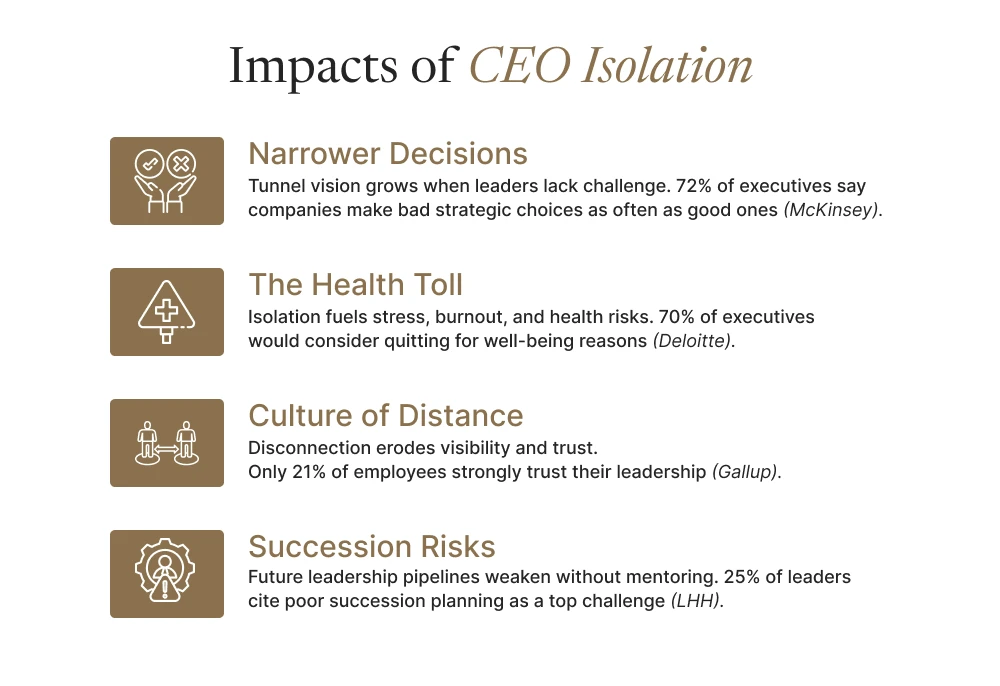
A Narrowing of Decisions
When fewer people challenge you, perspective narrows. McKinsey found that 72% of top executives believe their companies make as many bad strategic choices as good ones, a sobering reminder of what tunnel vision costs at scale. For isolated CEOs, decisions aren’t just harder; they’re riskier.
The Health Toll
Chronic stress and loneliness are proven accelerants for burnout, depression, and even heart disease. Deloitte reported that 70% of executives would consider quitting their jobs for their well-being. If leaders are ready to walk away, the personal toll has already crossed into the organizational one.
A Culture of Distance
When CEOs slip into isolation, the disconnect quickly spreads through the organization. Leaders appear less visible and approachable, eroding trust and transparency, which is already fragile, with Gallup finding that only 21% of U.S. employees strongly trust their leadership. The result is slower communication, weakened morale, and a culture that drifts.
Risks of Leadership Succession
CEO isolation often sidelines the mentoring of future leaders, leaving succession pipelines fragile. Research shows that 25% of executives cite succession planning as a top leadership challenge. Without CEO engagement, organizations face critical transitions unprepared and vulnerable to disruption.
6 Practical Strategies to Overcome CEO Isolation
Isolation at the top is not inevitable; it’s a risk that can be anticipated and managed. The key lies in building intentional systems of support rather than waiting for loneliness to erode judgment, energy, or resilience.
The good news is that isolation doesn’t have to be permanent. With deliberate strategies, CEOs can create the systems and relationships that keep them connected and resilient.
Below are practical, evidence-based strategies that CEOs can adopt to protect themselves and their organizations from the hidden costs of isolation.
Establish Peer CEO / Executive Circles
One of the most effective ways to combat isolation is by connecting with other leaders who truly understand the weight of the role. Peer groups, whether formal CEO networks, mastermind circles, or curated retreats, create a safe space to share challenges, ask for feedback, and realize you’re not alone.
Imperium’s “Leading the Change: Foresight for a Shifting World” is designed for the kind of peer connection most CEOs rarely get in their day-to-day. Hosted in Mallorca, Spain (May 20–24, 2026), it brings together a curated group of 25 senior executives for four focused days, small enough for honest conversation and structured enough to go beyond surface-level networking. The retreat centers on the realities leaders are being tested on right now: making decisions in uncertainty, reading weak signals before they become disruptions, and building future-ready teams and cultures. The outcome isn’t just insight; it’s leaving with a trusted circle that reminds leaders they’re not carrying the role alone.
In these circles, conversations go beyond surface-level updates. Leaders talk openly about struggles like board conflicts, succession planning, or personal burnout, topics they can’t always share with employees or investors.
The best part? Everyone in the room understands, because they’re living through it too.
Hire a Coach or Trusted Advisor
Every top athlete has a coach. Why shouldn’t CEOs? A leadership coach or trusted advisor provides a confidential sounding board where you can work through dilemmas without judgment. They help sharpen decision-making, challenge blind spots, and hold you accountable to your goals.
Research confirms the impact of coaching on leadership performance. A Frontiers in Psychology study found that executive coaching reduces burnout and boosts energy among leaders.
At the same time, industry surveys reveal that over 75% of CEOs believe coaching directly improves their performance, clarity, and resilience.
Unlike peers or subordinates, coaches have no stake in the business outcome; their role is purely to support your growth and perspective.
Build Board Trust & Honest Feedback Loops
Boards are meant to guide and oversee, but for many CEOs, board meetings feel more like performance reviews. To break that pattern, shift the focus from proving performance to building trust. This means creating space for conversations about risks, blind spots, and challenges.
Harvard Business Review found that while CEOs naturally lean toward a performance-first mindset, leaders who balance it with benevolence and support experience less stress and loneliness. In practice, that can be as simple as sharing credit, acknowledging challenges openly, and inviting board members into problem-solving instead of after-the-fact judging.
When you model that candor, boards often reciprocate. Over time, these honest feedback loops turn the relationship from “them versus us” into a genuine governance partnership, one that reduces isolation and strengthens decision-making.
Invest in Leadership Development & Resilience Training
Leadership is demanding, but resilience can be learned and strengthened. Structured programs, such as those focusing on strategic thinking, authentic leadership, or emotional intelligence, provide CEOs with practical tools to manage stress and remain grounded in the face of pressure.
These initiatives aren’t just about skills; they also build networks. Learning in a room with other senior leaders creates a rare environment for candor and connection. Those bonds often outlast the classroom, giving CEOs a trusted peer group that acts as a buffer against isolation.
Prioritize Self-Care & Boundaries
Protecting your well-being is a leadership responsibility. The ability to think clearly, stay resilient, and remain connected to others depends on it.
There are two ways to approach it. First, look inward: treat yourself with the same fairness you extend to others. Accept that mistakes happen, and frame challenges as learning opportunities rather than as pass/fail tests. That mindset creates emotional distance from the relentless weight of performance.
Second, lean on your network: surround yourself with people who can support you and be deliberate about giving them the space and energy to do so. Even simple boundaries limiting availability, delegating , and practicing mindfulness can recharge you in ways that reduce isolation.
A well-rested, balanced leader doesn’t just survive the job; they show up sharper, more connected, and far less isolated.
Pursue Interests Outside Work
Being a CEO is a huge part of your identity, but it shouldn’t be your only identity. Leaders who invest in hobbies, community work, or personal passions often find balance and perspective that keeps them grounded.
Whether it’s running marathons, volunteering, painting, or spending time with family, activities outside the boardroom act as a reset button.
They remind CEOs that life is bigger than quarterly reports, and that joy and connection can come from places far removed from business.
Case Study
While statistics give us insight, real stories bring the issue to life. The following case study shows how isolation plays out in practice and what leaders can learn from it.
CEO loneliness is real. Chris Yeh, co-author of The Alliance and longtime Silicon Valley entrepreneur, has openly shared how his first company, SocialNet, left him feeling deeply isolated. Even surrounded by a small, ambitious team, Yeh recalls that:
“Every decision carried enormous weight; product direction, hiring, keeping the lights on. The pressure wasn’t just financial. It was personal. I felt like if I failed, it would affect not just me but everyone who trusted me.”
- Chris Yeh
The hardest part wasn’t the hours or workload; it was the loneliness of carrying decisions no one else could fully share. Friends and family cheered from the sidelines, but they couldn’t truly understand the relentless uncertainty of running a startup.
On the outside, he looked like a rising founder. On the inside, he battled sleepless nights, anxiety, and the sense of being trapped with no safe outlet for doubt.
When Chris Yeh later helped launch LinkedIn, the lessons carried over. He realized that resilience comes from more than just grit.
“Having peers who understand, routines that protect your mental health, and safe places to admit what you don’t know make all the difference.”
Lesson for CEOs: Even the most capable leaders risk burnout if they try to “carry it all” alone. Building peer networks, setting boundaries, and letting go of perfection are not weaknesses; they're the real foundation of sustainable leadership.
Conclusion
You didn’t become a CEO by accident. You earned the role through talent, grit, and vision. But as the role expands, so does its weight, and isolation can creep in, not because you lack people around you, but because you lack safe spaces where the truth can be said without consequences.
That matters because the cost of isolation is never just personal. It shows up in decisions, health, culture, and ultimately the company’s future. The good news is you don’t have to power through it. You can design support into the role. Build peer networks. Practice transparency and create deliberate spaces for honest conversation through coaching, trusted circles, or executive leadership retreats. Kept consistent, these systems shift isolation from a liability into a source of clarity and strength.
Lead like Mandela. “Lead from the back.” Build the circle and the bench so you’re never carrying the role alone.
FAQs
1. What is CEO Isolation?
Accordion content
2. Is CEO Isolation the same as loneliness?
Accordion content
3. How does CEO Isolation impact a company’s performance?
Accordion content
4. Can first-time CEOs avoid Isolation?
Accordion content
5. Why is coaching important for CEOs?
Accordion content
6. What causes CEO Isolation?
Accordion content
7. How can CEOs overcome Isolation?
Accordion content
8. What are the health risks of CEO Isolation?
Accordion content
9. How does CEO Isolation affect company culture?
Accordion content
10. Is CEO Isolation inevitable?
Accordion content
Vrisha Rongala
Ms. Vrisha Rongala is the Chief Growth Officer at Edstellar, where she leads brand and growth strategy. She began her career at JWT and Saatchi & Saatchi, working on campaigns for global brands including Infosys and Microsoft. At Edstellar, she has shaped the company’s identity and strengthened its enterprise presence as a one-stop talent development partner. She now leads Imperium, an executive strategy retreat for CEOs and founders focused on clear thinking and peer-level dialogue.
Search
Popular Posts
Related Post

Vrisha Rongala
/
Chief Growth Officer
Executive Resilience
Feb 25, 2026
Vrisha Rongala
/
Chief Growth Officer
Executive Resilience
Feb 20, 2026

Vrisha Rongala
/
Chief Growth Officer
Leadership Development
Feb 18, 2026