
Vrisha Rongala
Chief Growth Officer

The CEO job rarely breaks in one dramatic moment. It breaks in small, repeatable ways: one more meeting, one more decision, one more late-night reply, one more week where recovery gets postponed. Each is manageable on its own. Together, they create drift.
That drift has a name: CEO burnout. Not tiredness, not stress, not a temporary slump, but a sustained loss of energy and leadership capacity. When it sets in, judgment slows, patience thins, and the role starts to feel heavier than the results it produces.
The pattern is becoming widespread. Staffing Industry Analysts reports that 56% of leaders experienced burnout, resulting in a high churn rate: 43% of businesses lost at least half of their leadership teams. This high turnover comes at a steep price, with the cost of replacing a C-level executive estimated to be as much as 213% of their annual salary.
The key is to catch it early. This article walks through 9 CEO burnout symptoms and four practical resets that help leaders restore clarity, resilience, and momentum before the dominoes fall too far.
What Is CEO Burnout?
Burnout is categorized by the World Health Organization (WHO) as an “occupational phenomenon” with three main characteristics:
Sensations of fatigue or a lack of energy
Increased detachment from one’s work, or pessimistic or cynical sentiments
Decreased effectiveness as a professional
This can manifest in different ways for CEOs. Being at the top can make the experience even more intense due to the great responsibility and isolation that it entails. Being “on” and having all the answers all the time can be a burdensome burden.
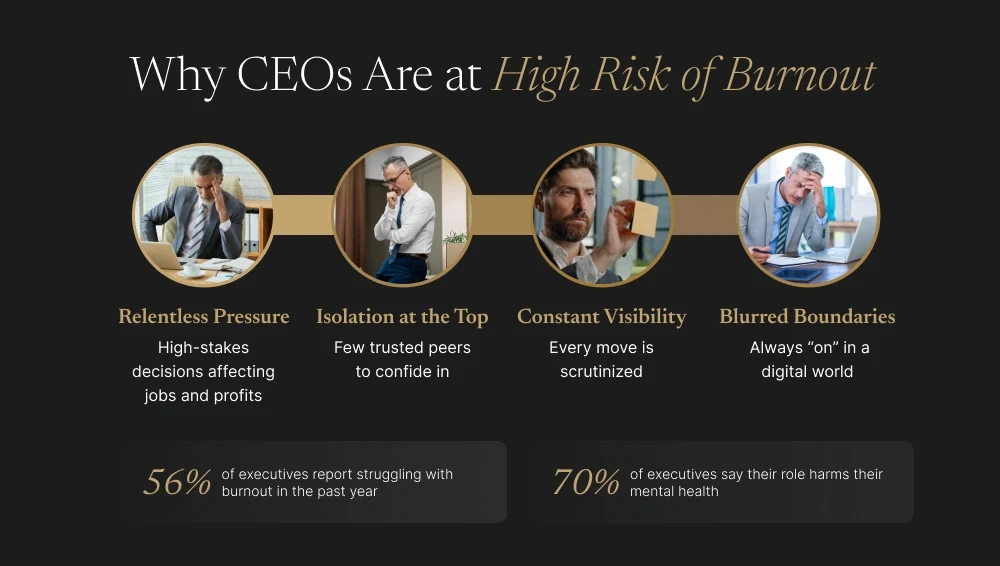
The CEO position is a breeding ground for burnout due to its basic structure:
Relentless Pressure: Every decision is high-stakes, affecting employees’ livelihoods and shareholders’ money.

“If you don’t have the mental space, the clarity, the conviction, and the energy to do the job, you are hamstringing the enterprise.”
Managing Director and Senior Partner at Boston Consulting Group
Isolation at the Top: Many CEOs lack peers inside the company with whom they can share struggles honestly.
Constant Visibility: CEOs are under the microscope; every statement and decision is scrutinized.
Blurred Boundaries: In a digital world, CEOs are “on” 24/7, making real downtime elusive.
9 Symptoms of CEO Burnout
You might be surprised to learn how frequent burnout is. According to Deloitte, 70 percent of C-suite executives in 2023 thought of leaving their current positions in favor of ones that promote their well-being.
CEO burnout develops gradually rather than all at once. Early detection of the warning indicators is essential for both individual health and company viability. Three categories can be used to classify these symptoms:
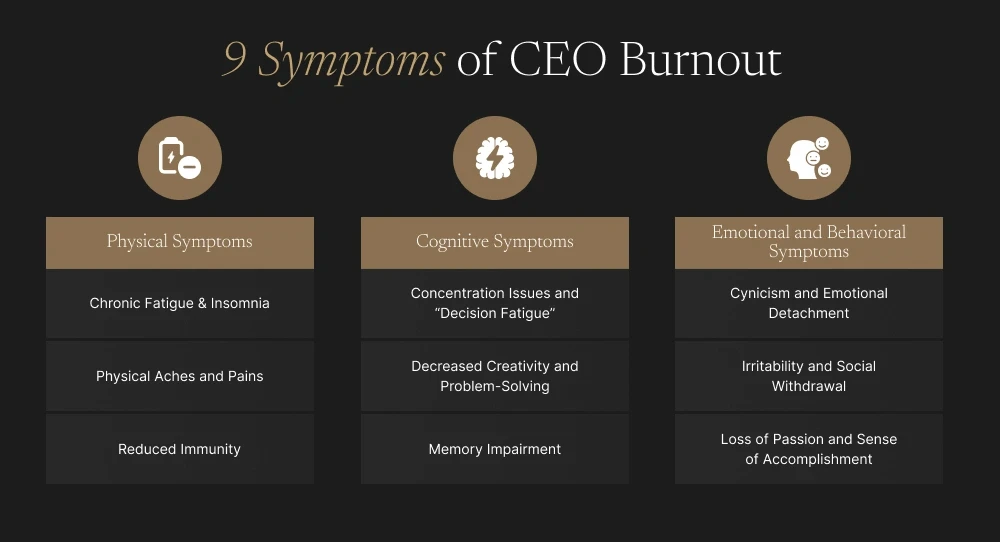
Physical Symptoms
The body is directly and visibly affected by long-term stress. No amount of rest may alleviate the lingering fatigue that a burned-out leader may experience.
Chronic Fatigue & Insomnia
This is more than just feeling exhausted. Simple chores feel like a Herculean effort because of this persistent tiredness. Ironically, insomnia, a mind that refuses to shut off, often coexists with chronic exhaustion, creating a vicious cycle of restless nights and exhausted days. Lack of restorative sleep affects cognitive performance, which makes it more challenging to lead successfully.
Physical Aches and Pains
Long-term stress triggers the body’s fight-or-flight response, leading to inflammation and tense muscles. Chief executive officers may experience frequent tension headaches, migraines, shoulder and neck pain, and even digestive problems as a result.
Reduced Immunity
The primary stress hormone, cortisol, weakens the immune system. The leader’s performance is further hampered by the body’s increased susceptibility to colds, the flu, and other diseases.
Cognitive Symptoms
Burnout’s psychological effects are the most harmful to a leader since they impair their capacity for wise decision-making and strategic thought.
Concentration Issues and “Decision Fatigue”
The continual need to be “on” causes mental tiredness, which makes it hard to concentrate. A CEO may find themselves having trouble making even little judgments, losing their train of thought during meetings, or repeatedly reading the exact text. This condition, referred to as “decision fatigue,” can result in poor decision-making and strategic errors.
Decreased Creativity and Problem-Solving
The creative process is inhibited by burnout. Chronic stress reduces the activity of the brain’s prefrontal cortex, which is responsible for creative and long-term thinking. This can result in the loss of the innovative edge that frequently characterizes a great leader, stagnation of ideas, and a dependence on outdated tactics.
Memory Impairment
A leader experiencing burnout may experience a “mental fog,” which causes them to lose track of critical details from recent conversations or to miss deadlines. This is often the first indication that the brain is struggling with the heavy cognitive load.
Emotional and Behavioral Symptoms
These signs indicate a significant change in how a leader views their job and the people in their immediate vicinity.
Cynicism and Emotional Detachment
A burned-out leader may start to detach from their work as an emotional coping strategy. Growing skepticism about the company’s goals, employees, and even their own accomplishments can be one way this shows up. Employees may sense the leader’s lack of interest, which can create a poor work environment and lower morale.
Irritability and Social Withdrawal
A shorter fuse results from a diminished emotional reserve. A CEO can get irritable, overreact to minor irritations, or snap at family members and coworkers. The “lonely at the top” condition is exacerbated when a leader withdraws socially, cutting off contact with friends, family, and even team members.
Loss of Passion and Sense of Accomplishment
A leader no longer finds purpose in the task that once motivated them. Even with significant victories, there is no sense of fulfillment. Finding the will to take on the next challenge might become even more difficult as a result of this loss of purpose, which can set off a vicious cycle of indifference.
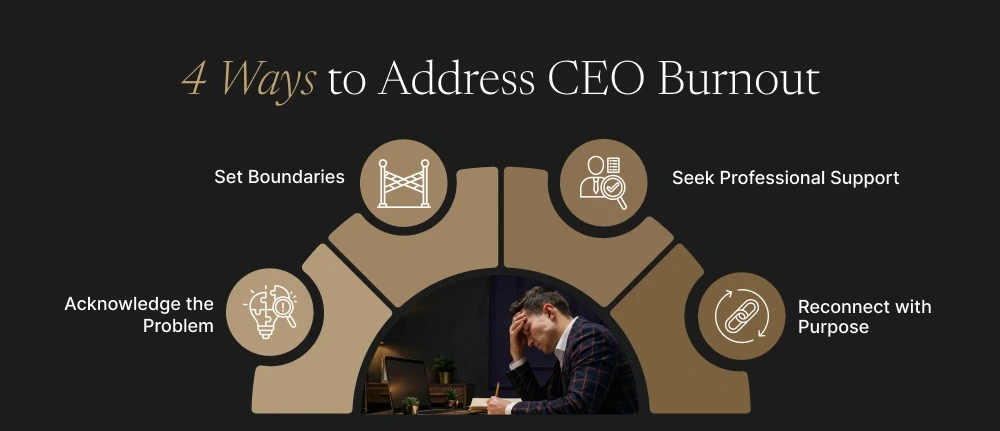
Recognizing the symptoms of burnout is only the beginning. The fundamental transformation happens when awareness translates into deliberate action. For CEOs, taking the first steps toward recovery is both a personal necessity and a strategic move for the business.
Acknowledge the Problem
The first step in preventing burnout is acknowledging its existence. The World Health Organization has recognized burnout as a recognized occupational syndrome, not a personal shortcoming.
However, 56% of executives report experiencing burnout in the last 12 months, and far too many delay addressing it until the symptoms start to impact their work. Admitting that burnout exists is a crucial leadership move for CEOs.
Set Boundaries
52% of leaders claim that stress at work has negatively impacted their mental health, according to leadership statistics provided by ZipDo. Setting aside protected leisure is crucial in a world when CEOs are “on” all the time.
This could entail designated breaks, work-free weekends, or hours of digital detoxification. The ideal setting for practicing and establishing these limits is a CEO retreat, which gives leaders a fresh start they can implement back into their everyday lives.
Seek Professional Support
No leader must battle burnout by themselves. Medical professionals, coaches, and therapists all provide unbiased techniques and tools that can have a quantifiable impact.
According to one study, senior-level executives at Fortune 1000 organizations who participated in coaching reported significant advantages, including a 53% increase in productivity and improvements in profitability, customer service, and retention.
Having outside assistance is not a luxury for CEOs; rather, it is an investment in their own well-being and the success of their businesses.
Reconnect with Purpose
Burnout doesn’t just drain energy. It corrodes meaning. When that happens, even wins feel muted, and the work starts to look like an endless cycle of delivery without direction.
Reconnecting with purpose requires more than rest. It requires perspective. CEOs need space away from the operating tempo to re-examine what matters, what is no longer working, and what the organization truly needs next.
When purpose gets blurred, distance and the right room can restore it faster than another productivity push.
Imperium’s “Leading the Change” retreat is designed to help CEOs and founders step out of reaction mode and think with range again. In Mallorca (May 20–24, 2026), a small, curated cohort works through the forces reshaping leadership and pressure-tests priorities through honest peer exchange. Leaders return with renewed direction and relationships that extend beyond the retreat.
When that direction is clear again, motivation stops being something leaders chase. It becomes the byproduct of alignment between their role, their choices, and the future they are building.
Conclusion
Burnout isn’t a personal breakdown. It’s what happens when the role runs without recovery built into the system. The signs show up early, in fatigue that doesn’t clear, decisions that take longer than they should, and a quiet detachment from work that used to feel sharp. If those signals are present, the risk is not just health. It’s judgment, culture, and pace.
The solution is not another productivity push. It’s stepping out long enough to regain perspective, then returning with a cleaner operating rhythm. That reset often happens faster in the right environment than it ever does inside the calendar.
That is the point of Imperium. It is a curated retreat experience designed for CEOs and founders who need space to think clearly again, pressure-test priorities with peers, and rebuild the mental and strategic range the role demands. If that sounds like what’s missing right now, explore upcoming Imperium retreats or reach out to discuss a tailored experience for your organization.
FAQs
1. What are the earliest warning signs of CEO burnout?
Accordion content
2. How does CEO burnout impact the organization?
Accordion content
3. Can CEO burnout be prevented, or is it inevitable?
Accordion content
4. What role should boards play in addressing CEO burnout?
Accordion content
Vrisha Rongala
Ms. Vrisha Rongala is the Chief Growth Officer at Edstellar, where she leads brand and growth strategy. She began her career at JWT and Saatchi & Saatchi, working on campaigns for global brands including Infosys and Microsoft. At Edstellar, she has shaped the company’s identity and strengthened its enterprise presence as a one-stop talent development partner. She now leads Imperium, an executive strategy retreat for CEOs and founders focused on clear thinking and peer-level dialogue.
Search
Popular Posts
Related Post

Vrisha Rongala
/
Chief Growth Officer
Executive Resilience
Feb 25, 2026
Vrisha Rongala
/
Chief Growth Officer
Executive Resilience
Feb 20, 2026

Vrisha Rongala
/
Chief Growth Officer
Leadership Development
Feb 18, 2026