
Vrisha Rongala
Chief Growth Officer

In the relentless arena of modern business leadership, CEOs face a paradox: the faster they move, the less clearly they see. Between quarterly earnings calls, board meetings, operational fires, and stakeholder demands, the space for genuine strategic thinking has become a luxury many cannot afford, or so they believe. Yet some of the world's most successful CEOs have discovered a counter-intuitive truth: stepping away is often the fastest path forward.
Recent research by Superhuman reveals that 56% of leaders experience burnout, a crisis that not only threatens individual well-being but also undermines organizational stability and innovation. Against this backdrop, executive retreats have evolved into more than mere perks; they're essential tools for achieving sustainable high performance.
According to The Wall Street Journal, Bill Gates's legendary "Think Weeks" gave birth to Internet Explorer, as well as countless breakthrough strategies conceived in quiet reflection away from corporate headquarters. Retreats offer CEOs what daily office life cannot: perspective, renewal, and the mental space to lead with clarity.
This article explores four transformative benefits that make retreats indispensable for today's executive leaders.
Let’s dive in.
Top 4 Benefits CEOs Gain from Attending Retreats
Far from escapes, retreats deliver the conditions needed for renewed leadership capacity and excellence. As the business world becomes increasingly complex, structured retreat time is emerging as a non-negotiable practice for top-performing executives.
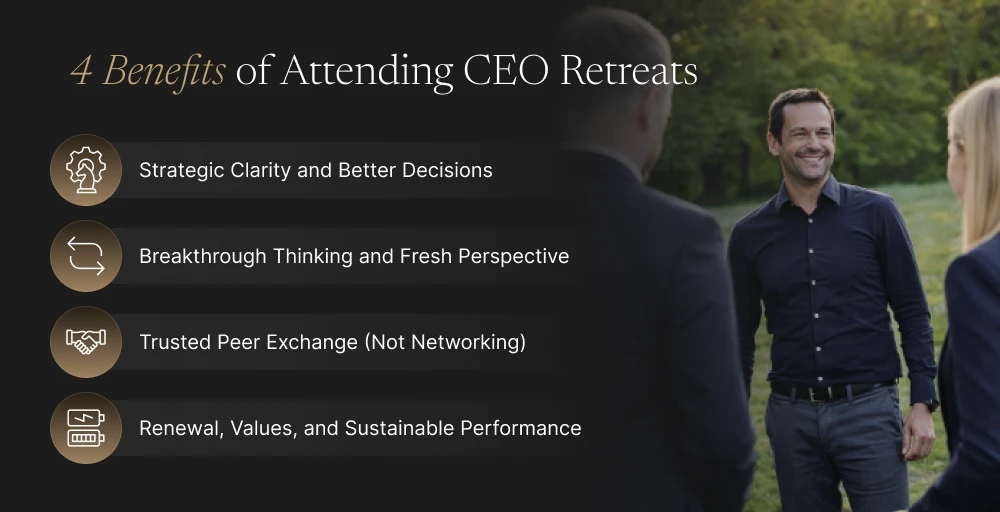
Strategic Clarity and Better Decisions
The first payoff of a CEO retreat is cognitive distance. When the operating noise drops, you can finally see patterns you can’t detect from inside the machine. That’s when strategy stops being “more analysis” and becomes clearer priorities, including a stop list: what to pause, cut, delegate, or decline so the next quarter isn’t dragged down by yesterday’s defaults.
Ken Chenault’s crisis-era leadership at American Express is a useful illustration: stepping away from the constant operational pull created space to rework the cost structure, evaluate real options, and move with speed and discipline. That’s what the right executive retreats protect the conditions for high-quality thinking, especially when the environment is turbulent.
A CEO retreat also improves decision quality for a simple reason: fatigue corrupts judgment. Under chronic stress and poor sleep, executives don’t just feel tired; they become more reactive, more binary in their thinking, and more likely to treat everything as urgent. The reset built into strong executive retreats fewer inputs, better rest, and time for reflection restores the bandwidth needed to hold multiple variables, think in second-order consequences, and make calls without anxiety, driving the wheel.
But the highest-level benefit isn’t just “better decisions.” It’s better judgment: selecting the right problems, calibrating risk, and choosing which trends deserve commitment. Satya Nadella’s early Microsoft moves, cloud-first posture, openness to open source, and conviction around platform shifts weren’t isolated decisions. They were judgment calls about where the world was heading and what had to change culturally and strategically to meet it.
Breakthrough Thinking and Fresh Perspective
A CEO retreat is one of the few environments that reliably produces breakthrough thinking, not because it’s “inspiring,” but because it removes the two things that kill original thought: constant interruption and constant context. When you change the environment and slow the input stream, you stop recycling the same assumptions and start seeing new options.
This is why executive retreats often lead to better problem-solving than another marathon of meetings. In day-to-day operations, the brain optimizes for execution: speed, continuity, and quick closure. On a retreat, you get space for reflection, longer arcs of thinking, and the ability to ask better questions about what’s actually changing, what we’re ignoring, what we’re over-investing in, and what we should stop doing.
Leaders like Sundar Pichai have leaned into this logic culturally, creating room for teams to step back, learn across domains, and experiment rather than staying trapped in delivery mode. That same principle scales to the CEO level: distance restores range.
You also get cross-domain input that breaks echo chambers. Strong CEO retreats introduce perspectives outside your usual industry logic operators, technologists, economists, geopolitical context, and customer shifts, so your strategy isn’t just “more of what worked last quarter.”
And sometimes the result is a true reframing. Jaydeep Barman’s pivot at Rebel Foods, realizing they weren’t a restaurant business but a food delivery business, captures the kind of shift that usually only happens when leaders get out of the day-to-day noise long enough to see what the business really is (and what it’s becoming). That’s the core promise of a well-designed executive retreat: not relaxation, but a clearer view of reality and the strategic courage that follows from it.
Trusted Peer Exchange (Not Networking)
The real “peer advantage” of a CEO retreat isn’t business cards or polite dinners. It’s access to a truth-telling room, a space where leaders can say what they can’t say inside their own company, and get feedback that isn’t filtered by politics, incentives, or hierarchy.
That’s what separates strong executive retreats from generic networking events:
Candor replaces performance: Extended time together builds enough trust for real conversations: what’s breaking, what’s unclear, what you’re avoiding, and what you already know needs to change.
Peer calibration beats solo guessing: CEOs don’t just need ideas; they need reality checks. A room of experienced operators helps you pressure-test assumptions, spot blind spots, and reduce the risk of confident mistakes.
Ongoing advisory value: The best retreat relationships don’t end at checkout. They turn into a small, informal advisory layer of people you can call when a board issue, talent decision, or strategic fork shows up.
Sara Blakely has spoken about the value of candid founder peer relationships, getting honest input, avoiding avoidable mistakes, and finding opportunities that wouldn’t come from conventional networking.
That’s the point: retreats create conditions where the relationship is built on usefulness, not social polish. And the learning is practical, not theoretical. CEOs trade real patterns: what worked, what failed, and what they wish they’d seen earlier. Leaders like Arvind Krishna have emphasized the value of learning through candid exchange and lessons from setbacks. That’s what peer-to-peer learning in a CEO retreat setting actually is: compressed experience transfer, with enough trust to tell the truth.
Renewal, Values, and Sustainable Performance
A strong CEO retreat doesn’t just produce strategy outputs. It restores the leader behind the strategy. When you step away from constant delivery pressure, two things come back online: recovery and meaning. That combination is what turns “high performance” into something you can sustain without becoming colder, narrower, or chronically depleted.
The payoff isn’t vague wellness. It’s operational: clearer emotional regulation, steadier judgment, and a return to work with fewer false urgencies. Leaders like Arianna Huffington have been blunt about what happens when you ignore recovery until your body forces it, while others, including Marc Benioff, have built deliberate stress-reduction practices because the cost of running hot shows up directly in decision quality and leadership presence. A well-designed executive retreat accelerates that reset by removing noise long enough for the nervous system to downshift and thinking quality to rise again.
Just as important, retreats create space for values and identity alignment, which is the part most CEOs lose quietly. When purpose blurs, everything starts to feel like throughput. Retreat time lets leaders pressure-test what they’re building (and why), tighten the standards they’re operating by, and rebuild a decision framework that’s anchored in more than urgency. Leaders like Howard Schultz and Indra Nooyi have used reflection-heavy offsites to reconnect to mission, adjust leadership behavior, and steer transformation with more conviction. And when the role stops consuming the person when there’s a self beyond the title, resilience stops being a “trait” and becomes a system.
Net: CEO retreats and executive retreats are not indulgences. They’re the mechanism for renewing attention, re-aligning values, and keeping performance durable instead of brittle.
Conclusion
Executive retreats have become a necessity, not a luxury, for leaders navigating constant change. They’re one of the few repeatable ways to rebuild the asset the role burns fastest: clear thinking under pressure. When you never step out of the operating tempo, you stop seeing the business; you only see the next obligation. That’s how smart leaders drift into reactive strategies, make worse talent calls, and move more slowly while convincing themselves they’re just “busy.”
A good CEO retreat does what the calendar can’t. It creates distance, signal, and a truth-telling room with enough space to decide what changes, what stops, and what actually matters next. The outcome isn’t relaxation. It’s sharper judgment, cleaner priorities, and a leadership posture you can sustain.
Imperium’s “Leading the Change” retreat (Mallorca, May 20–24, 2026) is built for CEOs and founders who need to step out of reaction mode and think with range again. In a small, curated cohort, leaders pressure-test their biggest bets through candid peer exchange and outside perspective, then return with decisions they can stand behind, not just decisions they can defend.
If you’re evaluating options, Imperium is built around exactly that: stepping out of reaction mode long enough to think with range again.
Vrisha Rongala
Search
Popular Posts
Explore Topics
Related Post
Vrisha Rongala
/
Chief Growth Officer
Executive Resilience
Feb 5, 2026

Vrisha Rongala
/
Chief Growth Officer
Stakeholder Alignment
Feb 2, 2026

Vrisha Rongala
/
Chief Growth Officer
Executive Resilience
Jan 30, 2026