
Vrisha Rongala
Chief Growth Officer

Work–life balance isn’t about splitting your day into neat halves. For a CEO, it’s about staying fit for the role.
Because when recovery disappears, it doesn’t just hit your mood. It hits judgment. Decisions take longer. Patience gets shorter. You default to what’s safe instead of what’s right.
There’s a reason this shows up fast at the top: research associated with Stanford economist John Pencavel suggests output drops sharply past ~50 hours a week, with steep diminishing returns after ~55. Past that point, you’re “working more,” but producing less, and the gap gets paid for in decision quality.
Most CEOs can push through a heavy week. The real damage comes from making “temporary” overload your permanent operating model.
So work-life balance isn’t a lifestyle goal. It’s leadership discipline: protecting the energy and clarity your company depends on. In this article, we’ll break down what balance actually looks like at the CEO level, what to protect, and what to cut to stay effective without burning out the rest of your life.
6 Risks CEOs Face When Overwork Becomes the Norm
When overwork becomes routine at the top, the damage isn’t limited to personal fatigue. It changes how the company thinks.
Strategic Clarity Degrades
The first thing that slips is strategic clarity. When the CEO is mentally depleted, decisions become more reactive. Long-term bets feel heavier, and short-term fixes, cost-cutting, postponing investment, and playing defense start to look “practical.” Over time, that trade-off quietly drains innovation and future readiness.
Innovation and Foresight Get Throttled
The second casualty is creative range. Foresight requires spare cognitive capacity: pattern recognition, synthesis, and the patience to sit with ambiguity. Under constant pressure, that capacity collapses. In industries where timing and signal-reading matter, a burned-out CEO can unintentionally anchor the organization in yesterday’s model.
Low-Leverage Work Crowds Out High-Leverage Outcomes
Overwork often disguises itself as productivity. But performance comes from where the CEO spends attention. A Harvard study of 1,100+ CEOs found that leaders who prioritized high-level, cross-functional, and external engagements rather than getting trapped in routine tasks saw stronger outcomes, including a reported 7% increase in firm sales. The message is clear: when the CEO is stuck in low-leverage work, the business pays for it.
Innovation Execution Fails, Not Just Innovation Ideation
Overwork also makes innovation harder to execute, not just harder to imagine. A survey on innovation fatigue found common blockers such as weak executive coordination, difficulty attracting innovation talent, and excessive bureaucracy, exactly the issues that get worse when the CEO doesn’t have the bandwidth to align leaders, cut through noise, and keep momentum.
Culture Absorbs the Strain
Then it spreads into culture. CEOs set the behavioral ceiling. If exhaustion is normalized at the top, it becomes permission for stress, burnout, and disengagement to spread downward. People stop recovering, stop thinking, and start operating in survival mode.
Health and Decision Quality Deteriorate
There’s also a human cost that isn’t abstract. Research from the Rodney L. White Center for Financial Research links sustained CEO stress to measurable health impacts, including signs of accelerated aging and higher mortality risk during downturns. And sleep loss becomes a direct business risk: 90% of CEOs report losing sleep over fears of failure. That deficit shows up as cognitive fog, slower decisions, weaker judgment, missed signals, and avoidable strategic errors.
Overwork isn’t a badge at this level. It’s a compounding risk first to the CEO’s clarity, then to the organization’s trajectory.
7 Modern Leadership Habits CEOs Use to Balance Performance and Well-Being
Some of the world’s most influential leaders argue that balance is not about rigid separation but about integration. Jeff Bezos, for example, frames it:
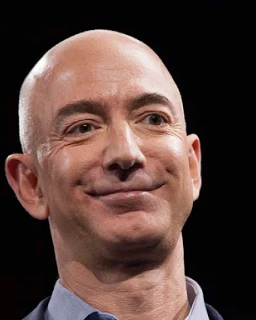 | “Consider work and personal time as one big overlapping circle rather than two separate parts that occasionally intersect. I call this work-life harmony, and it’s something I emphasize to both new employees and senior executives at Amazon. The phrase ‘work-life balance’ is actually debilitating, because it implies a strict trade-off between the two.” Jeff Bezos (Amazon Founder & Former CEO) |
|---|
Modern CEOs are moving beyond hustle culture and adopting systems that sustain clarity, creativity, and resilience. The goal is not simply to work fewer hours, but to work with sharper focus and healthier energy, creating an environment where leadership decisions remain strategic rather than reactive.
Here are 7 strategies modern leaders use to balance performance and well-being.
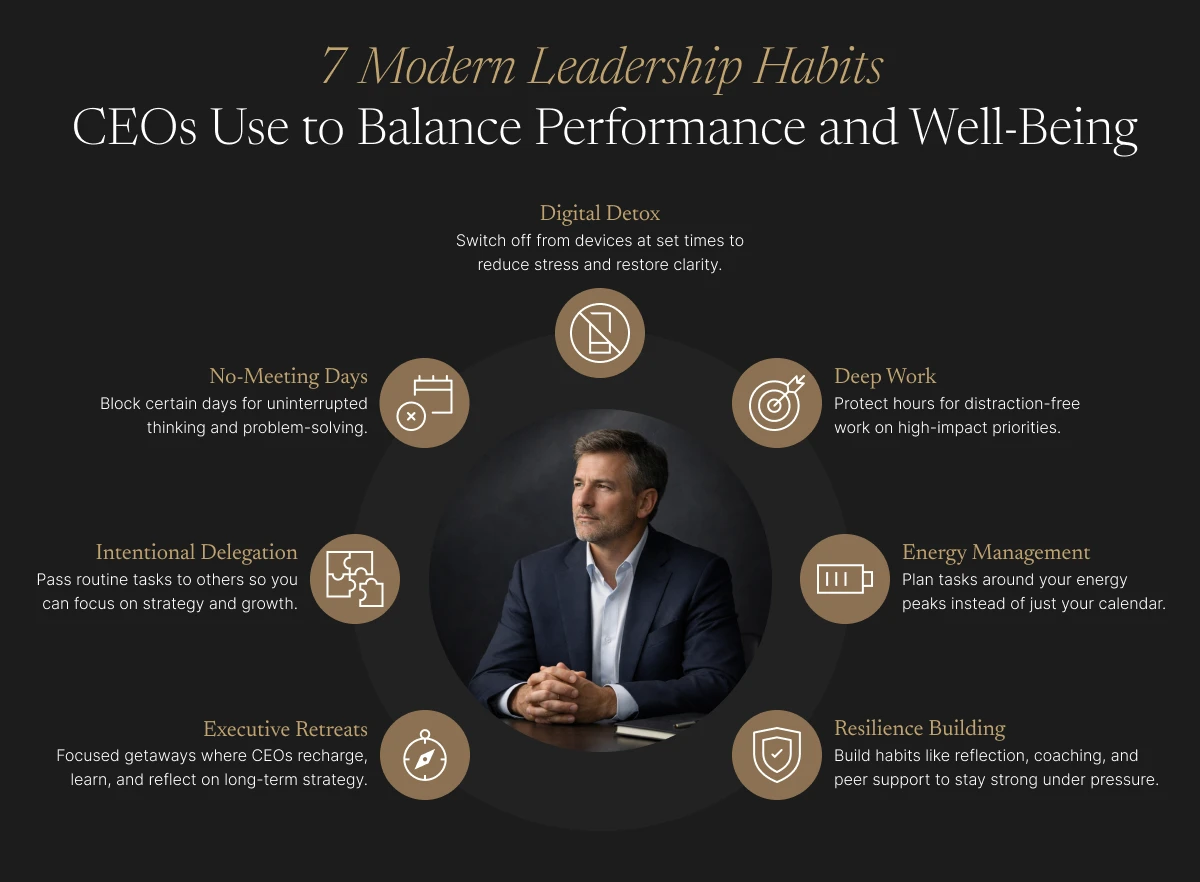
Executive Retreats: Resetting Perspective and Clarity
For CEOs, work-life balance is not always about daily routines; it sometimes requires stepping away altogether. Executive retreats are emerging as powerful platforms where leaders can pause, gain perspective, and return with renewed clarity and focus.
Unlike traditional wellness retreats that focus solely on relaxation or conferences that overwhelm with panels and noise, CEO retreats are designed to integrate rest, learning, and strategic reflection.
In these settings, leaders find the space to disconnect from operational pressures and reconnect with long-term vision. Structured activities often combine mindfulness practices, peer networking, and immersive sessions with faculty or coaches, alongside lighter experiences that make the retreat feel restorative. The mix of professional growth and vacation-like downtime allows CEOs to recharge while sharpening their leadership edge.
One example is Imperium’s “Leading the Change” retreat in Mallorca, Spain (May 20–24, 2026), a small, curated CEO/founder gathering designed to help leaders step out of reaction mode and reset perspective. The focus is clear thinking, honest peer exchange, and time away from constant operational pull, so leaders return with sharper priorities and renewed leadership range.
Intentional Delegation: Leading by Letting Go
High-performing CEOs recognize that doing everything themselves is unsustainable. Instead, they empower capable leaders across the organization by delegating with intent, prioritizing strategic impact over operational control.
CEOs who master the art of delegation avoid burnout and build stronger leadership pipelines within their organizations. A long-term Harvard Business School study on how CEOs allocate time found that effective delegation correlates strongly with long-term success.
Key findings:
The average CEO works 62.5 hours per week
Time spent on “company organization and culture” had the most positive long-term impact
CEOs who delegated routine tasks were better able to focus on strategic direction
To delegate intentionally, CEOs often begin by auditing their own calendar, identifying decisions or meetings that no longer need their direct input. Some also implement delegation playbooks that clarify ownership and create accountability across leadership tiers.
No-Meeting Days: Creating Space for Strategic Thinking
Inundated calendars can stall innovation. By intentionally carving out time free from meetings, CEOs are reclaiming space for reflection, strategy, and creative problem-solving. Meeting overload severely disrupts deep thinking and creativity.
Implementing this often starts with one designated day per month, clearly communicated and protected across teams before evolving into a recurring practice. Leaders also batch meetings on specific days to avoid scattering focus across the week.
Digital Detox and Technology Boundaries
Today’s leaders are always connected, but often at the cost of clarity and cognitive bandwidth. Creating intentional disconnection windows is becoming critical to sustaining long-term leadership performance. Constant digital connection leads to cognitive fatigue and poor decision-making. Mental focus declines sharply when leaders are constantly interrupted by emails, messages, and digital alerts.
Tech boundaries, like screen-free hours or digital sabbaticals, are emerging as essential leadership tools. Some CEOs define ‘offline hours’ and publicly commit to them, while others rely on chiefs of staff or executive assistants to filter communications during high-focus periods. Weekend email pauses and post-evening shutdown routines are also becoming standard.
Deep Work: Protecting Time for High-Impact Thinking
Deep, uninterrupted work is a strategic advantage. CEOs who prioritize deep focus are better positioned to steer their organizations through complex challenges and long-term planning. Tom Karwatka (former CEO of Divante) detailed how restructuring his week to enable more deep work led to him feeling more productive and having more creative ideas.
He achieved this by batching meetings and setting daily highlight goals aligned with the company’s strategy. Many leaders now block 2–4 hour deep work windows weekly, protected from interruptions by default calendar settings. Some pair this with personal assistant triage or even working offsite to enhance focus.
Energy Management over Time Management
Elite CEOs are shifting from managing time to managing energy, recognising that sustained performance comes from aligning work with peak energy, not the clock.
Research from The Energy Project and Harvard Business Review has shown that managing energy, both physical and emotional, is more effective than managing time alone. Leaders who align their tasks with energy peaks and incorporate restorative practices are better focused, more resilient, and less burned out.
This might include planning strategic work during peak morning hours, scheduling low-energy tasks in the afternoon, and incorporating microbreaks between meetings. Some CEOs track their energy rhythms weekly to fine-tune their schedules accordingly.
Resilience-Building as a Leadership Competency
Resilience is no longer viewed as a personal trait; it’s a critical leadership muscle. CEOs are proactively investing in emotional and mental resilience to navigate complexity and pressure with clarity. Executive resilience is a predictor of sustainable success. CEOs who engage in practices such as mindfulness, journaling, coaching, or emotional intelligence development are shown to handle stress better and make more balanced decisions.
Additionally, peer groups like YPO and CEO coaching networks often integrate resilience-building into their programming, recognizing its ROI for leadership and organizational health.
To embed this into daily routines, some leaders start their mornings with short reflection practices, engage in peer advisory groups, or schedule regular sessions with executive coaches. These rituals don’t just buffer stress; they sharpen decision-making over time.
Executive Well-Being in Action: 3 Real-World Examples
Today’s most effective CEOs don’t leave balance to chance; they engineer it through deliberate choices, systems, and habits. While philosophies vary, what unites top leaders is a data-informed approach to managing energy, attention, and organizational influence. The following real-world examples illustrate how executives across various industries have implemented effective strategies to maintain high performance while prioritising well-being.
Harvard Time‑Use Study – Structured Balance Through Personal Agenda
Faced with the challenge of optimizing executive time in high-pressure environments, Harvard Business School conducted a detailed study tracking 27 global CEOs. The research analyzed over 60,000 hours of CEO activity, recorded 24/7 over 13 weeks, using 15-minute time blocks.
The findings revealed a pattern of overextension in operational duties and reactive decision-making, prompting a call for deliberate time structuring. CEOs who adopted personal agenda frameworks and quarterly alignment sessions demonstrated significantly stronger strategic execution.
The study monitored CEO schedules to determine how much time was spent on strategy versus operations. It also evaluated how consistently leaders aligned their time investments with stated goals and how effectively they delegated responsibilities. The average CEO worked 62.5 hours per week, but high performers spent more time on strategy, talent, and culture. Only 11% of the time was spent on routine tasks, highlighting the effective delegation among top-tier leaders. CEOs who aligned time with personal agendas showed greater clarity in decision-making and stronger leadership influence.
Ultimately, the research reinforced a key insight: strategic use of time, not just long hours, defines effective leadership. Personal agendas, when applied with discipline, help CEOs stay focused on high-value contributions while reducing reactive effort
Laxman Narasimhan, Starbucks – Boundary-Defined Work Hours
Recognizing the toll of blurred boundaries between work and personal life, Starbucks CEO Laxman Narasimhan established a rule: no meetings after 6 PM, unless truly essential. He intended to model sustainable executive behavior and foster a healthier work culture across global teams.
Rather than enforcing the rule top-down, Narasimhan communicated it through leadership channels, reinforcing the message through his own behavior. Over time, senior leaders began limiting non-urgent meetings outside core hours.
This shift increased focus during core hours, improving meeting quality and efficiency. It also strengthened executive team morale, as leaders felt empowered to follow suit. The move reinforced a culture of respect for personal time, especially in hybrid/remote work environments.
Boundaries signaled not a lack of commitment, but a tone of discipline and respect, ultimately elevating both individual well-being and team performance.
Mike Spears, Lee & Associates – Prioritizing Family Presence
Mike Spears, CEO of Lee & Associates Houston, openly reflects on the importance of being present for his family, a shift prompted by early career regrets. Now, Spears turns off work entirely during family time, encouraging leadership teams to embrace similar habits.
He modeled this behavior consistently, sharing his approach with team members during leadership meetings and informal check-ins. This transparency prompted broader conversations around work-life balance.
As a result, the company created a more empathetic and values-driven culture. Leaders began normalizing flexible work decisions, reducing stigma around family-first priorities. This shift contributed to lower turnover and stronger employee engagement across roles.
By leading with vulnerability and values, Spears created a culture where well-being and performance are not at odds, but rather reinforce one another.
Conclusion
Work–life balance at the CEO level isn’t a feel-good concept. It’s a performance safeguard. When recovery is missing, decision quality drops, foresight narrows, and the organization begins to inherit the leader’s fatigue through slower calls, weaker alignment, and a culture that normalizes strain.
The executives who sustain performance don’t “find time.” They build constraints: fewer low-leverage decisions, clearer boundaries, protected thinking time, and rhythms that prevent overload from becoming normal. The goal isn’t to work less. It’s to stay sharp enough to lead well consistently, not occasionally.
And if you’re already running hot, the fastest reset is rarely another habit tracker. It’s distance. A well-designed CEO retreat creates the space most calendars can’t: to step out of reaction mode, pressure-test priorities, and return with clearer judgment and renewed leadership range.
FAQs
Vrisha Rongala
Search
Popular Posts
Explore Topics
Related Post

Vrisha Rongala
/
Chief Growth Officer
Executive Resilience
Feb 5, 2026

Vrisha Rongala
/
Chief Growth Officer
Stakeholder Alignment
Feb 2, 2026

Vrisha Rongala
/
Chief Growth Officer
Executive Resilience
Jan 30, 2026