
Vrisha Rongala
Chief Growth Officer

In 2026, global expansion still matters. It’s one of the few levers that can reliably unlock new revenue, diversify risk, and deepen talent access.
But the rules have changed.
Geopolitics isn’t a background variable anymore; it’s shaping trade, regulation, and supply decisions in real time. Economic uncertainty is sticking around longer than most forecasts predicted. And AI is compressing the time between sensing a shift and acting on it.
So the question isn’t “Where can we grow?”
It’s “Where can we grow without becoming fragile?”
That’s the mindset behind this guide. Not a list of tactics you can copy-paste but a set of practical moves C-suite teams can use to expand with speed, discipline, and resilience. As Peter Drucker put it: “In turbulent times, managers cannot assume that tomorrow will be an extension of today.”
Recent global analysis points in the same direction. Companies are dealing with uneven inflation pressure, supply-chain redesign, and faster tech cycles all at once. Since mid-2024, global core inflation has been around the 4.5% range, keeping cost pressures high while growth expectations remain high.
At the same time, global trade is getting more selective. Major economies have been pulling trade closer to “safer” relationships. In practice, this means fewer blanket globalization plays and more targeted, region-anchored bets.
And AI is becoming a growth multiplier, not because it’s trendy, but because it helps leaders decide faster, allocate capital better, and scale execution without adding unnecessary complexity.
Rethinking Global Strategy in a Volatile World
The reality in 2026 is simple: volatility is no longer occasional. It’s layered.
Trade friction, regulatory shifts, supply constraints, and changing customer expectations are happening together. That combination breaks linear planning. You can’t run global expansion on static forecasts and annual strategy refresh cycles.
The winners are building something different: agile, data-led expansion systems.
That means:
Planning in scenarios, not single forecasts
Monitoring signals early, not after results show up
Ajusting market bets quickly, without internal chaos
This shift is backed by research. A BCG study showed that companies combining strong organizational learning with AI-driven capabilities, which it describes as “Augmented Learners,” are significantly more likely to handle volatility well. The idea isn’t “AI replaces judgment.” It’s “AI improves judgment.”
They use AI to run simulations, pressure-test assumptions, and spot shifts faster. The payoff is speed: faster pivots, less downtime, and better capture of emerging demand pockets.
Economic signals add more urgency. Many executives still see recession risk as realistic. The response isn’t to freeze. It’s to build expansion strategies that are stress-tested by design so you can move forward without betting the company on a single macro outcome.
From a C-suit leader, the takeaway is this: global expansion in 2026 is less about predicting perfectly and more about adapting faster than conditions change.
12 Strategies Organizations Need to Win Global Expansion in 2026
To thrive, leaders must implement these strategies holistically, tailoring them to specific contexts while leveraging supporting research for validation.
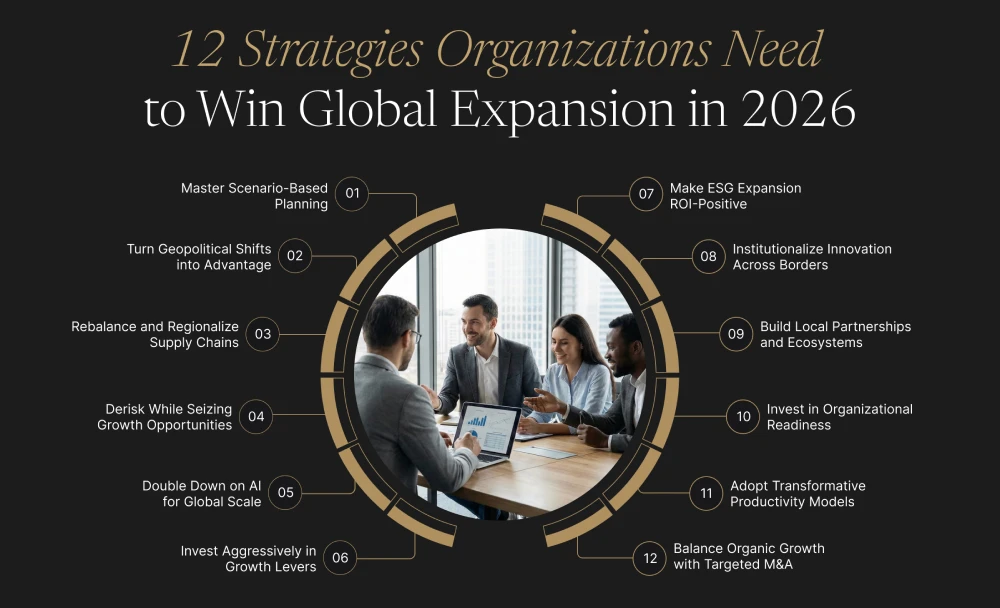
Master Scenario-Based Planning
Most global expansion plans fail for one reason: they assume the next 12 months will behave like the last 12 months. In 2026, that’s a dangerous assumption.
When we evaluate new markets, we don’t bet on a single forecast. We build around a small set of plausible scenarios: demand shock, tariff change, currency swings, and regulatory shifts, and we decide in advance what we’ll do in each case. McKinsey’s economic outlook work shows many executives continue to factor recession risk into their planning, which makes scenario discipline a core expansion capability, not a nice-to-have.
What winning teams do differently:
Define 3–4 scenarios: with clear trigger signals (not 10 “what-ifs”)
Pre-commit moves: what we pause, accelerate, exit, or double down on
Run quarterly war-games: with Sales, Ops, Finance, and Legal, and update assumptions fast
The outcome is simple: faster decisions under pressure, fewer expensive surprises, and expansion that stays resilient even when the environment turns.
Turn Geopolitical Shifts into Advantage
We’ve stopped treating geopolitics as a risk appendix to the strategy deck. In 2026, it is the strategy because it decides where we can operate, what we can ship, who we can partner with, and how quickly we can scale.
When the rules of trade, data, and regulation shift, markets don’t just become “harder” or “easier.” They reprice. Some routes to market get blocked overnight. Others open up because competitors hesitate, compliance gets tighter, or supply chains reroute.
So our approach is simple: we don’t ask, “Is this market attractive?”
We ask, “Under which geopolitical conditions does this market become attractive, and what’s our move when conditions change?”
In practical terms, that means we build geopolitical signals into growth decisions, just as we track pipeline and margin. And we don’t wait for annual planning cycles to respond.
What we do to stay ahead:
Run a monthly geopolitical review tied to real decisions: pricing, contracting, vendor exposure, market entry timing.
Maintain two entry paths for priority markets (direct + partner, or hub-and-spoke + local entity), so we’re not stuck when constraints hit.
Choose regions where we can diversify exposure so one tariff, one policy shift, or one compliance change doesn’t stall the full expansion plan.
The payoff isn’t just “risk reduction.” It’s speed. When others freeze, we already know what we’ll do, and we move.
Rebalance and Regionalize Supply Chains
We learned the hard way that a supply chain optimized for the lowest cost can be the most expensive thing you own when disruption hits. Port congestion, input shortages, and tariff whiplash don’t just delay delivery; they distort margins, working capital, and customer trust.
So in 2026, we’re not “reshoring for the headlines.” We’re rebalancing for control. Deloitte’s work on managing supply chains amid tariffs makes the point clearly: resilience, agility, and cost discipline have to be designed together, especially as trade volatility becomes the new normal. Deloitte also frames the shift many leaders are making: moving from a singular focus on resilience to a smarter balance between resilience and efficiency.
What this looks like in practice is more practical than dramatic:
Map dependencies tier-by-tier (where a single supplier or geography can stop the business)
Build regional hubs for priority markets closer to demand, faster to adapt
Keep a dual-track network (global scale + regional fallback), so one disruption doesn’t become a full reset
The payoff: shorter recovery time, fewer margin shocks, and expansion that doesn’t collapse the moment the trade environment shifts.
Derisk While Seizing Growth Opportunities
High-growth markets don’t come gift-wrapped. The same forces that drive policy change, capital inflows, and fast-shifting demand also create volatility. If we demand certainty before we enter, we’ll always be followers. If we chase growth blindly, we’ll pay for it in write-offs, stalled execution, or reputational risk. So we don’t treat “risk” as a separate workstream. We build it into the growth move itself.
Take Sub-Saharan Africa: the IMF’s April 2025 Regional Economic Outlook projects growth of 3.8% in 2025, rising to 4.2% in 2026, driven by reforms and investment momentum in parts of the region, while warning that debt and external shocks remain real constraints. That combination is exactly why a “big-bang entry” approach fails.
Instead, we structure expansion like an options portfolio. We enter in a way that keeps upside open and downside capped. We pilot before we scale. We design contracts and pricing to absorb volatility. And we choose partners and operating models that let us move fast without overcommitting fixed costs too early.
The win isn’t just safer growth. It’s repeatable growth, the kind we can scale across regions without reinventing the playbook every time the ground shifts.
Double Down on AI for Global Scale
By 2026, “using AI” isn’t the differentiator; scaling it into the operating model is. Most companies have pilots. Many have pockets of success. Very few have turned AI into a repeatable engine that improves decisions, execution speed, and unit economics across markets.
McKinsey’s 2025 State of AI survey makes that adoption gap obvious: 78% of respondents say their organizations use AI in at least one business function, and 71% report regular use of generative AI. But the same report is also a warning: despite widespread experimentation, more than 80% say they’re not yet seeing tangible enterprise-level EBIT impact from gen AI.
That’s the line we can’t cross: high activity, low impact.
So when we “double down,” we don’t mean buying more tools. We mean doing three unglamorous things really well: picking the few cross-border workflows that actually move margin (service ops, sales enablement, forecasting), locking data and governance so reuse is easy, and forcing adoption until AI becomes the default way work gets done, not an optional add-on.
Invest Aggressively in Growth Levers
In 2026, we can’t rely on organic momentum alone; markets are more competitive, customer acquisition is more expensive, and differentiation erodes faster.
So we don’t spread capital thin across ten initiatives. We pick the levers that scale across geographies with the least friction, digital distribution, premium segments, and regions where wealth and demand are structurally rising.
BCG’s Global Wealth Report 2025 is a useful signal here: global financial wealth hit $305 trillion in 2024, driven by 8.1% growth in financial assets, with North America and Asia-Pacific among the fastest-growing regions. That doesn’t mean “expand everywhere.” It means we align our expansion bets to where purchasing power is deepening and build growth engines that can capture it repeatedly.
Where we place the chips:
We invest in digital-first acquisition and conversion, because it scales faster than field-heavy growth
We build offers for high-value segments (not just mass reach), because of the margin for funds expansion
We fund repeatable GTM plays that can be cloned market-to-market, instead of being reinvented each time
When we do this well, expansion stops being a series of one-off launches and becomes a system that keeps producing growth.
Make ESG Expansion ROI-Positive
If ESG shows up in our expansion plan as a “values statement,” it won’t survive budget pressure. In 2026, ESG only sticks when it’s tied to revenue protection, margin, and risk.
The consumer signal is already clear: PwC’s global Voice of the Consumer survey (20,000+ consumers across 31 countries/territories) found people say they’re willing to pay an average 9.7% more for sustainably produced or sourced goods, even while cost-of-living pressure is still high. PwC also reports 85% of consumers say they’re experiencing the disruptive effects of climate change in their daily lives. That combination matters: sustainability is no longer a “nice-to-have,” but it competes directly with price and trust.
So we treat ESG as an expansion lever, not a compliance checklist:
Pick 2–3 measurable ESG outcomes that match the market reality (energy use, waste, responsible sourcing, labor standards)
Build them into the offer and operating model, not just brand messaging
Track ESG like we track growth: cost impact, conversion impact, retention impact
When ESG is measurable and commercial, it stops being a cost center and becomes part of why customers choose us in new markets.
Institutionalize Innovation Across Borders
One of the fastest ways to stall global expansion is to centralize innovation too tightly. What works in one market rarely translates cleanly into another, yet fully decentralizing innovation creates duplication, fragmentation, and slow learning. So we don’t choose between global and local. We design for both.
The idea is simple: innovation has to travel, but it can’t be copy-pasted blindly. Harvard Business Review has described this balance as managing an “imitation radius” knowing what can be reused at scale and what must be adapted locally. Organizations that get this right move faster because they’re not reinventing everything, and they’re not forcing local teams to work with ideas that don’t fit their reality.
In practice, this means we give regions the freedom to solve local problems but within clear global guardrails. Core platforms, architectures, and priorities stay consistent. Execution, adaptation, and experimentation happen closer to the customer.
We also make learning move faster than hierarchy. When a market figures out a better way to price, deliver, or engage customers, that insight doesn’t stay local; it gets absorbed and reused elsewhere.
The result is innovation that compounds globally instead of fragmenting relevant in each market, but scalable across all of them.
Build Local Partnerships and Ecosystems
In many markets, especially where institutions are fragmented or relationships matter more than contracts, credibility isn’t something we can import; it has to be earned locally.
That’s why we don’t think of partnerships as a shortcut. We treat them as infrastructure.
Whether it’s a local firm, an industry body, or a public-sector stakeholder, the right partner gives us context we can’t get from dashboards, on how decisions are really made, what customers value, and where the informal lines of influence sit. Harvard Business Review’s work on foreign market entry reinforces this point: companies that anchor expansion around trusted local allies move faster because they don’t start from zero credibility.
But partnership-driven expansion only works if it’s intentional. We’re selective about who we work with, clear about where value is shared, and disciplined about governance. Not every market needs a joint venture, but every market needs an ecosystem strategy.
When partnerships are well-designed, they do three things at once: accelerate entry, reduce reputational risk, and embed the business into the local operating fabric. That’s not just faster expansion, it’s more durable expansion.
. Invest in Organizational Readiness
We can have the best market thesis in the world and still fail if the organization can’t execute at global speed. Expansion breaks down in the messy places: slow decisions, unclear ownership, “HQ knows best” behaviors, and leaders who haven’t built the muscle to operate across cultures, time zones, and regulatory realities.
In 2026, organizational readiness isn’t HR’s job. It’s a growth constraint. SHRM’s CHRO Priorities and Perspectives report makes the same point from the people-leader side: organization design and change management is one of the top priorities for 2025 (listed by 30% of CHROs). That matters because it tells us what’s really slowing companies down: structure, decision rights, and change capability.
So we treat readiness like we treat go-to-market: we build it deliberately. We invest in leaders who can run distributed teams, we train for cross-border execution (not generic “culture training”), and we redesign decision-making so regions can move without waiting for HQ approvals. When the org is ready, expansion stops being a heroic effort and becomes repeatable.
. Adopt Transformative Productivity Models
If we expand globally using the same operating model we used in one market, we don’t scale; we multiply friction. More handoffs. More approvals. More meetings. More rework. That’s how “growth” quietly becomes a margin problem.
The uncomfortable truth: productivity is not automatically improving just because we have better tools. Accenture points out that global productivity has stayed largely flat, and 40% of large companies they analyzed saw negative productivity growth, while the top performers are pulling away, improving productivity 8%+ per year.
So we treat productivity as a design decision, not an efficiency project.
What this looks like for global scale is three shifts:
Standardize what should be standard (core processes, data definitions, templates) so we stop reinventing the basics market-by-market
Automate work that doesn’t deserve human attention, using gen AI to lift both speed and quality, not just cut costs
Invest in skills like it’s a growth lever because productivity leaders are more likely to tie training directly to success, not treat it as optional
Done right, productivity becomes our silent expansion advantage: faster execution, cleaner handoffs, and more scale without bloating headcount.
. Balance Organic Growth with Targeted M&A
Organic expansion is the long game. It’s how we earn credibility, build distribution, learn the market, and develop internal capability we can reuse elsewhere. But it’s also slow, and in some geographies, speed is the difference between entering early and arriving after the market has been priced by competitors.
That’s why we keep M&A on the table but only as a precision tool, not a growth habit. The deal environment reinforces this. EY-Parthenon’s 2025 deal barometer points to restrained activity in volume terms and makes the case implicitly and explicitly that value will come from sharper deal logic and better execution, not simply doing more deals.
Where teams mess this up is that they treat acquisitions like shortcuts. They aren’t. They are fast only when integration is planned upfront, and synergy assumptions are honest. We’ve seen enough deals fail because the numbers looked great and the integration was an afterthought.
So our approach is simple: we build by default, and we buy only when it clearly accelerates one of three things: market access, capability, or strategic infrastructure. If a deal doesn’t strengthen our position within 12–18 months, it’s not expansion, it’s distraction.
That’s what “balanced” really means in 2026: speed where it matters, discipline everywhere else.
Case Study: AI-Driven Forecasting Fuels Scalable Growth in Southeast Asia
A leading global technology company leveraged artificial intelligence (AI) to drive precision forecasting and market responsiveness during its expansion into Southeast Asia, one of the most dynamic yet complex regions for digital growth.
Using predictive analytics and AI-powered demand sensing, the company localized its go-to-market strategy, dynamically adjusting pricing, product bundles, and promotional timing. This approach enabled near real-time response to shifting customer behavior, supply fluctuations, and competitive moves.
According to McKinsey’s 2025 State of AI Report, this resulted in 15% reduction in operational costs and also a 10% increase in revenue within the first 18 months of entry. The company’s AI deployment went beyond back-end efficiency; it was integrated into the core business strategy, empowering local managers with data-driven decision-making capabilities at scale.
Key Takeaway for Executives: AI is not just a cost-cutting tool; it is a strategic accelerator for hyperlocal responsiveness and operational resilience in unfamiliar markets.
Conculsion
Global expansion in 2026 is constrained by judgment.
The strategies outlined in this guide make one thing clear: success doesn’t come from picking the “right” country or deploying the latest tool. It comes from how leadership teams interpret signals, make trade-offs, and act under uncertainty again and again, across regions, cycles, and shocks.
What separates organizations that scale from those that stall is not access to information. It’s the quality of leadership conversations behind closed doors:
How clearly we see second- and third-order effects
How decisively we balance speed with resilience
How aligned the C-suite and Board are on what not to pursue
These are not decisions that can be rushed through quarterly reviews or fragmented across functional silos. They require space, perspective, and peer-level dialogue away from operational noise.
That’s precisely where executive retreats play a critical role.
At Imperium, we’ve designed CEO and CXO retreats as strategic thinking environments, not off-sites. They bring senior leaders together to step back from execution and pressure-test how they’re navigating transformation, global expansion, and leadership complexity in real time.
Imperium: Leading the Change is a flagship CEO retreat built for leaders who are driving growth amid volatility.
The retreat focuses on strategic clarity, leadership alignment, and decision-making in moments of disruption, covering topics such as global expansion, AI-led transformation, organizational readiness, and enterprise-wide change.
Through curated peer discussions, expert-led sessions, and real-world case exploration, leaders gain perspective on how others are approaching similar challenges and where their own strategies need recalibration.
In a world where global expansion is increasingly fragile, the advantage belongs to leaders who think better together before they act alone.
The next phase of global growth won’t be led by those with the boldest plans but by those with the clearest judgment, the strongest alignment, and the discipline to adapt faster than the environment changes.
That’s the leadership challenge of 2026. And it’s one worth stepping back to get right.
FAQs
Vrisha Rongala
Search
Popular Posts
Explore Topics
Related Post

Vrisha Rongala
/
Chief Growth Officer
Executive Resilience
Feb 5, 2026

Vrisha Rongala
/
Chief Growth Officer
Executive Resilience
Jan 30, 2026

Vrisha Rongala
/
Chief Growth Officer
Executive Resilience
Jan 30, 2026