In today’s rapidly evolving business landscape, CEO succession planning has emerged as the most critical board practice requiring immediate attention. According to the National Association of Corporate Directors, CEO succession planning ranks as the top priority for corporate boards heading into 2026, with directors recognizing that strategic clarity and disciplined execution are essential for navigating economic volatility and technological transformation.
The stakes have never been higher. With 42% of talent management executives citing the creation of succession strategies as a top focus area for 2026, organizations are increasingly turning to specialized CEO succession planning companies to navigate this complex, high-stakes process. These firms bring decades of expertise, data-driven methodologies, and proven frameworks that can mean the difference between seamless leadership transitions and costly organizational disruptions.

“Succession planning is the most important task a CEO faces; it is not about timing my departure, but ensuring the institution is ready for tomorrow’s challenges.”
CEO of JPMorgan Chase & Co-Chairman
Understanding CEO Succession Planning in 2026
CEO succession planning is far more than identifying a replacement when a leader departs. It represents a strategic, continuous process designed to ensure seamless leadership transitions while safeguarding operational stability and long-term growth. In 2026, this process has evolved significantly, incorporating artificial intelligence, predictive analytics, and sophisticated leadership assessment tools that enable organizations to build robust leadership pipelines years in advance.
Modern succession planning addresses three critical timelines: emergency succession (immediate replacement needs), medium-term orderly transitions (planned departures within 12-24 months), and long-term leadership development (cultivating internal talent over 3-7 years). Each timeline requires distinct strategies, assessment criteria, and development interventions that specialized firms have refined through thousands of executive placements.
The complexity intensifies when considering that 61% of CEOs with eight-plus years of tenure also chair their boards, creating dual succession challenges. Furthermore, research suggests that better succession planning could help the large-cap US equity market achieve valuations 20-25% higher, underscoring the tremendous financial impact of getting succession right.
Leading CEO Succession Planning Companies Shaping 2026
Russell Reynolds Associates
Headquarters: New York City, USA
Clients: Microsoft, JPMorgan Chase, PepsiCo, General Motors
Russell Reynolds Associates stands out as a premier choice for organizations prioritizing data-driven leadership advisory and behavioral rigor. The firm has developed comprehensive frameworks that integrate CEO succession with board effectiveness and executive team development, recognizing these three elements as an interconnected system that evolves together.
Russell Reynolds’ approach emphasizes creating internal leadership pipelines while maintaining flexibility to explore external candidates when strategic circumstances demand fresh perspectives. Their proprietary assessment methodologies evaluate not just technical competencies but also cultural fit, adaptability to future business models, and the capacity to drive transformation in increasingly complex environments.
Spencer Stuart
Headquarters: Chicago, USA
Clients: Unilever, Amazon, Johnson & Johnson, Boeing
Renowned for high-stakes board appointments and CEO succession planning, Spencer Stuart combines advisory excellence with a long track record of successful placements. The firm often partners with boards years before anticipated transitions, embedding succession planning into regular governance practices rather than treating it as a crisis-driven activity.
Spencer Stuart’s methodology includes creating detailed CEO success profiles aligned with future organizational needs, conducting rigorous talent assessments of internal candidates, and implementing structured development programs that prepare high-potential leaders for executive roles. Their research shows that robust succession planning considers the CEO, top team, and board as interconnected elements requiring synchronized development.
Korn Ferry
Headquarters: Los Angeles, USA
Clients: Coca-Cola, Netflix, General Electric, Pfizer
As one of the largest executive search firms globally, Korn Ferry brings unparalleled scale and sophisticated assessment technologies to CEO succession planning. The firm has invested heavily in AI-powered predictive analytics that evaluate leadership potential, cultural alignment, and future-readiness across diverse candidate pools.
Korn Ferry’s best practices for 2026 emphasize making succession planning an “always-on” activity rather than periodic review, balancing internal development with external exploration, defining the “CEO of the future” based on emerging strategic requirements, and preparing for both planned transitions and emergency scenarios simultaneously.
Heidrick & Struggles
Headquarters: Chicago, USA
Clients: IBM, Intel, American Express, McDonald’s
Recognized for structured, assessment-driven approaches, Heidrick & Struggles excels at integrating psychometric evaluations, 360-degree feedback, and simulation-based assessments into comprehensive succession strategies. The firm’s methodology ensures that succession decisions rest on objective evidence rather than subjective impressions or internal politics.
Heidrick’s 2026 approach places particular emphasis on diversity, equity, and inclusion in succession planning, helping organizations broaden their candidate pools and challenge unconscious biases that historically limited leadership diversity. This focus aligns with growing board recognition that diverse leadership teams drive innovation and improve organizational performance.
Egon Zehnder
Headquarters: Zurich, Switzerland
Clients: Nestlé, Siemens, Roche, Shell
Egon Zehnder has distinguished itself through deep expertise in leadership succession risks and mitigation strategies. The firm identifies six critical risks that undermine succession planning: lack of formal plans, choosing wrong successors, resistance to change, inadequate candidate development, poor transition management, and failure to evaluate succession effectiveness.
Their consultative approach involves intensive board education, helping directors understand their specific succession responsibilities and creating accountability structures that ensure consistent progress. Egon Zehnder emphasizes alignment with business strategy, ensuring leadership pipelines support long-term organizational objectives rather than perpetuating status quo capabilities.
Critical Challenges Facing CEO Succession Planning in 2026
Despite heightened awareness, organizations face significant succession planning challenges that specialized firms help navigate:
Macro-Environmental Volatility
Economic uncertainty, geopolitical instability, and rapid technological disruption create unpredictable leadership requirements. The CEOs who succeeded in stable 2010s environments may lack the agility, resilience, and transformational capabilities needed for 2026’s turbulent landscape. Succession planning companies help organizations define future-oriented leadership profiles that anticipate rather than react to market shifts.
AI and Technology Integration
With 76% of directors citing artificial intelligence as central to 2026 growth strategies, succession planning must identify leaders capable of driving technology adoption while managing associated risks. However, most boards report only modest success realizing operational benefits from tech investments, highlighting the critical need for digitally fluent leadership.
Succession planning firms increasingly assess candidates’ technology literacy, innovation mindset, and ability to balance AI opportunities with ethical considerations and workforce implications. These competencies were peripheral five years ago but now represent core CEO requirements.
Workforce Adaptability and Talent Scarcity
Directors consistently cite workforce adaptability, organizational agility, and skilled talent shortages as top barriers to strategic execution. CEOs must not only navigate these challenges but also model adaptive leadership that inspires workforce resilience and continuous learning.
Specialized firms help boards evaluate candidates’ track records managing complex talent transformations, their cultural intelligence in diverse workplace environments, and their capacity to build inclusive organizations that attract and retain top talent in competitive markets.
CEO Isolation and Leadership Disconnect
One of the most overlooked yet damaging barriers to effective succession planning is CEO isolation, the profound disconnect that emerges when leaders become separated from authentic feedback, peer support, and the realities of their organization. Research shows that half of CEOs report feeling lonely, and 61% believe this isolation undermines their performance.
This isolation creates a dangerous vacuum in succession planning. When CEOs operate in disconnected environments, they often sideline the mentoring of future leaders, fail to transfer critical institutional knowledge, and inadvertently create succession pipelines that are fragile and unprepared. The most effective succession strategies therefore address not just technical capability gaps but also the relational and contextual barriers that prevent genuine leadership development from occurring.
Internal Politics and Hesitant Incumbents
Another delicate challenge involves managing incumbent CEOs who resist succession planning or subtly undermine potential successors. Harvard Business Review research identifies “hesitant CEOs” as a primary pitfall, where current leaders view succession as threatening their legacy or relevance rather than as stewardship responsibility.
External succession planning firms provide neutral facilitation that navigates these political dynamics, creating structured processes that balance incumbent engagement with objective candidate evaluation. Their independence allows boards to have difficult conversations and make decisions based on organizational needs rather than internal politics.
Best Practices for Effective CEO Succession Planning
Leading organizations and their succession planning partners follow proven practices that maximize transition success:
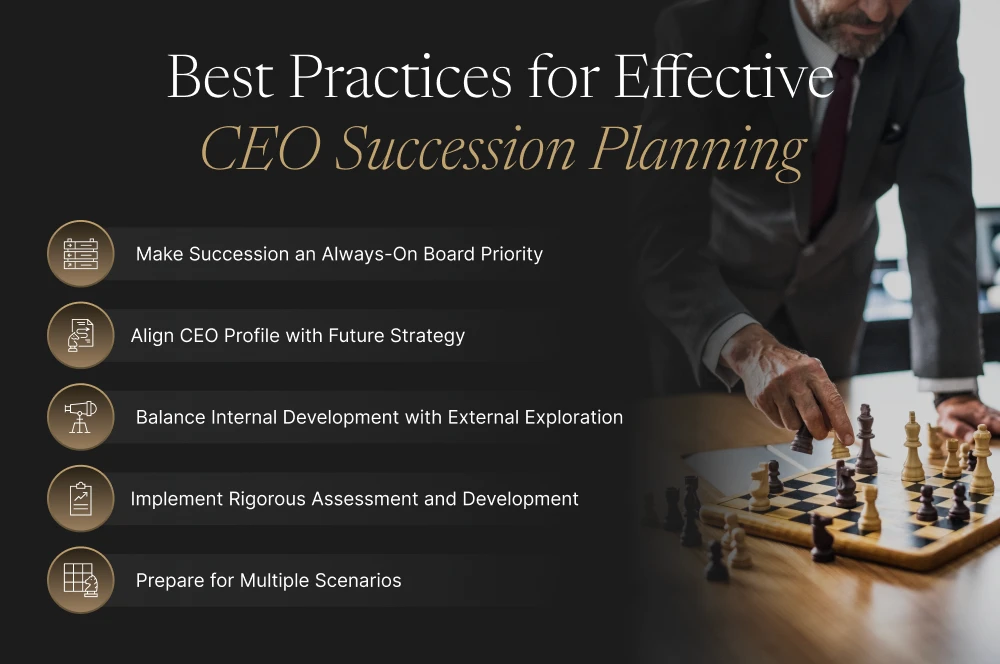
1. Make Succession an Always-On Board Priority
Rather than activating succession planning when CEOs announce departure intentions, world-class boards maintain continuous succession readiness. This includes regular reviews of internal talent pipelines, ongoing evaluation of the CEO's performance against evolving strategic requirements, and proactive relationship-building with potential external candidates.
Corporate governance experts recommend making CEO succession and leadership development a standing board agenda item, regularly reviewing and nurturing a pipeline of potential leaders rather than treating succession as an episodic crisis response.
2. Align CEO Profile with Future Strategy
Effective succession planning begins by defining the CEO of tomorrow based on where the organization needs to go, not where it has been. This requires rigorous strategic analysis, market forecasting, and honest assessment of current leadership gaps.
Succession planning experts emphasize creating detailed success profiles that specify required skills, experiences, traits, and cultural attributes. These profiles guide internal development investments and external search parameters, ensuring alignment between leadership capabilities and strategic imperatives.
3. Balance Internal Development with External Exploration
While developing internal successors builds organizational continuity and morale, an exclusive internal focus can perpetuate existing limitations and miss out on opportunities for transformational leadership. Leading firms advocate simultaneous internal development and external market awareness.
This balanced approach allows boards to make informed decisions based on comparative assessments rather than defaulted internal promotions or reactive external searches. It also creates healthy competition that elevates internal candidate performance while maintaining external optionality.
4. Implement Rigorous Assessment and Development
Subjective impressions and limited exposure provide insufficient foundations for selecting a CEO. Comprehensive succession planning incorporates psychometric assessments, behavioral interviews, simulations, 360-degree feedback, and external benchmarking against market standards.
PwC’s research on CEO succession planning identifies nine leading practices, including agreeing on the future CEO’s role and skills, clarifying ownership of the succession process, and establishing clear timelines and decision-making frameworks that prevent rushed or politically compromised selections.
5. Prepare for Multiple Scenarios
Effective succession planning addresses planned retirements, unexpected departures, emergency replacements, and performance-based transitions. Each scenario requires distinct preparedness strategies, communication plans, and activation triggers.
Leading companies maintain documented emergency succession protocols that identify interim leaders, expedite search processes, and establish stakeholder communication frameworks to minimize disruption during crisis transitions.
The Role of CEO Succession Planning Companies in 2026
CEO succession planning cannot be separated from broader leadership development initiatives. Organizations with strong succession outcomes systematically invest in leadership capabilities years before executive transitions.
Structured Development Programs
High-potential leaders identified through succession planning processes receive targeted development interventions including executive education, strategic project assignments, cross-functional rotations, external board service, and executive coaching. These experiences build the multidimensional capabilities required for CEO effectiveness.
Succession planning firms often design and facilitate these development programs, ensuring alignment between individual growth and organizational succession needs. Programs typically span 3-5 years, recognizing that executive capabilities develop through accumulated experience rather than short-term interventions.
Executive Peer Networks and Strategic Dialogue
Beyond internal development, successful succession planning recognizes that future CEOs benefit immensely from peer connections and external perspectives. Executive networks, CEO conferences, and strategic forums provide emerging leaders with exposure to diverse thinking, industry trends, and the kind of honest dialogue rarely available within their own organizations.
These platforms allow high-potential executives to build relationships with peers facing similar challenges, gain insights from experienced CEOs, and develop the strategic foresight needed for executive leadership. For organizations serious about succession preparedness, investing in these external learning opportunities for identified successors represents a strategic advantage that internal programs alone cannot provide.
The most sophisticated succession strategies therefore incorporate regular participation in curated executive forums where future leaders can pressure-test their thinking, expand their networks, and develop the nuanced judgment that distinguishes exceptional CEOs from merely competent ones.
Mentorship, Sponsorship, and Knowledge Transfer
Effective succession planning creates mentorship relationships between incumbent executives and emerging leaders. These relationships transfer institutional knowledge, build political acumen, and provide psychological preparation for the pressures of executive life.
However, mentorship alone proves insufficient. Research emphasizes the importance of sponsorship, where senior leaders actively advocate for successors, create visibility opportunities, and facilitate critical relationships that accelerate career progression. The combination of mentorship for development and sponsorship for advancement creates the robust support structures that enable smooth leadership transitions.
Measuring Succession Planning Effectiveness
Leading organizations and their succession planning partners implement metrics that track progress and outcomes:
Pipeline Strength: Number and quality of internal candidates ready for CEO role within 12, 24, and 36 months
Development Velocity: Rate at which high-potential leaders close capability gaps and assume greater responsibilities
Succession Readiness: Board and executive team confidence in succession preparedness across multiple scenarios
Transition Success: New CEO performance, stakeholder confidence, and organizational stability during first 18-24 months
Retention Rates: Percentage of non-selected internal candidates who remain with organization post-succession
These metrics enable continuous improvement, early problem identification, and board accountability for succession effectiveness rather than treating succession as unmeasurable governance obligation.
Conclusion
CEO succession planning in 2026 has become a continuous strategic discipline rather than an occasional governance exercise, directly shaping organizational stability, investor confidence, and long-term competitiveness. As boards confront economic uncertainty, technological disruption, and talent scarcity, collaboration with experienced CEO succession planning companies enables organizations to implement structured processes, objective leadership assessments, and transition frameworks that significantly reduce leadership risk while strengthening future executive pipelines.
However, external expertise delivers lasting results only when supported by sustained internal leadership investment. Organizations that embed succession planning into governance culture while strengthening leadership capability through structured development initiatives, peer learning platforms, and curated leadership development retreats for emerging and next-generation CEOs position themselves to manage transitions with confidence and continuity. In an increasingly volatile business environment, companies that proactively build succession readiness convert leadership change into opportunities for renewal and accelerated growth rather than periods of uncertainty and disruption.

Vrisha Rongala

Ms. Vrisha Rongala is the Chief Growth Officer at Edstellar, where she leads brand and growth strategy. She began her career at JWT and Saatchi & Saatchi, working on campaigns for global brands including Infosys and Microsoft. At Edstellar, she has shaped the company’s identity and strengthened its enterprise presence as a one-stop talent development partner. She now leads Imperium, an executive strategy retreat for CEOs and founders focused on clear thinking and peer-level dialogue.
Search
Popular Posts
Related Post

Vrisha Rongala
/
Chief Growth Officer
Executive Resilience
Feb 25, 2026
Vrisha Rongala
/
Chief Growth Officer
Executive Resilience
Feb 20, 2026

Vrisha Rongala
/
Chief Growth Officer
Leadership Development
Feb 18, 2026