
Vrisha Rongala
Chief Growth Officer

In 2026, the role of the Chief Executive Officer is more demanding than at any previous point in corporate history. CEOs must simultaneously deliver financial performance, lead enterprise transformation, manage geopolitical and regulatory uncertainty, respond to investor expectations, and build resilient organizations that can adapt to constant disruption.
Leadership expectations have expanded beyond operational execution. CEOs are now expected to function as strategists, transformation sponsors, cultural leaders, and external representatives of corporate purpose. Decisions increasingly influence talent, capital allocation, governance stability, and long-term competitiveness.
In this environment, executive coaching is no longer perceived as corrective support. Instead, CEO coaching programs have become strategic leadership investments used by boards and executive teams to strengthen leadership effectiveness, improve decision quality, and sustain enterprise performance.
This guide examines the most relevant CEO coaching program models globally and explains how boards and senior leaders should evaluate coaching investments in 2026. Rather than focusing on coaching firms, the analysis highlights program structures that consistently deliver measurable leadership impact at the CEO level.
Why CEO Coaching Matters in 2026
CEO coaching has become essential because leadership complexity has fundamentally changed.

“This directly reinforces your framing that CEO coaching is not remedial, it is performance acceleration at the highest level.”
Former CEO & Executive Chairman / Google
Decision Complexity Has Intensified
Executives are now required to make high-stakes decisions faster than ever, often under incomplete information. Prolonged exposure to strategic pressure increases the risk of decision fatigue, where judgment quality deteriorates over time, a growing challenge among senior executives managing sustained uncertainty. Coaching helps leaders reassess assumptions, slow critical decisions, and maintain clarity in volatile situations.
Transformation Is Continuous
Organizations rarely experience stable operating conditions. Digital disruption, automation, sustainability mandates, and evolving competitive landscapes force enterprises into continuous transformation. CEOs must manage change without sacrificing operational performance.
Executive Isolation Limits Perspective
As leaders rise, candid dialogue becomes scarce. Coaching provides a neutral space for reflection, enabling CEOs to explore strategic concerns without internal political consequences.
Governance Expectations Continue to Rise
Boards now expect CEOs to demonstrate adaptability, succession readiness, and stakeholder alignment beyond financial outcomes. Coaching programs increasingly support leaders in meeting these expectations.
Leadership Sustainability Is Becoming Critical
Modern CEOs operate under sustained performance pressure, increasing exposure to CEO burnout symptoms when recovery and reflection mechanisms are absent. Coaching programs help leaders maintain resilience and avoid performance decline, which can affect organizational stability.
Because of these factors, coaching programs now function as leadership infrastructure rather than optional executive benefits.
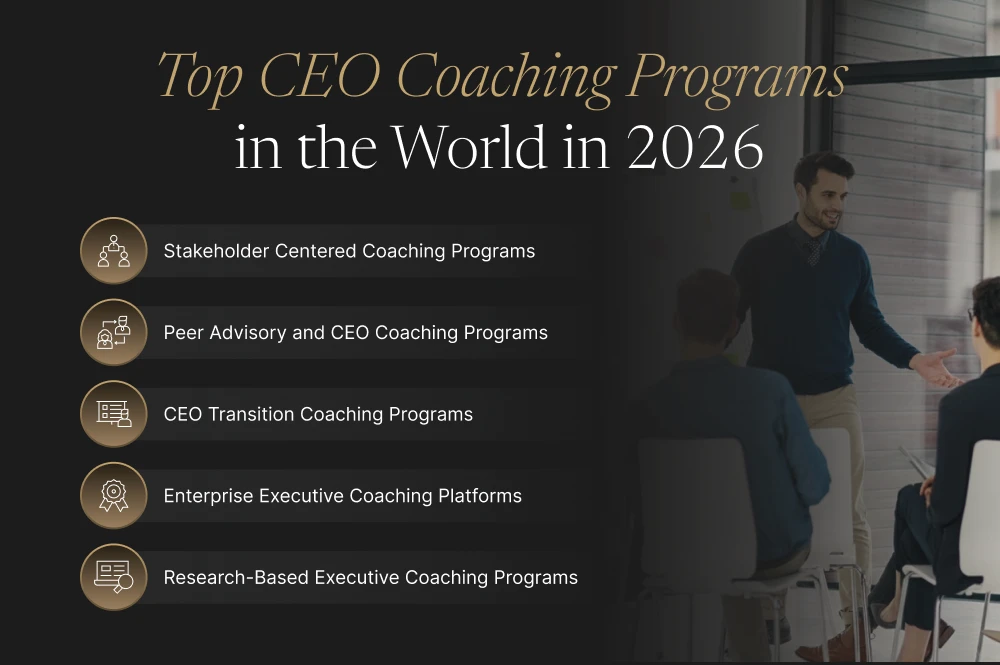
Top CEO Coaching Programs in the World in 2026
The following program models represent coaching approaches widely adopted by enterprise leaders globally. Each addresses distinct leadership challenges.
1. Stakeholder Centered Coaching Programs
Stakeholder-centered coaching focuses on measurable leadership behavior change validated by colleagues and organizational stakeholders.
The program typically begins with structured feedback identifying leadership behaviors requiring improvement. Coaches then work with CEOs to implement targeted behavioral changes. Progress is evaluated through repeated stakeholder feedback to confirm visible improvement.
Because success depends on external validation rather than personal reflection alone, leaders remain accountable throughout the coaching process.
This model is particularly effective when CEOs need to improve executive presence, collaboration, or leadership alignment across large enterprises.
Best suited for:
• CEOs influencing large organizations
• Leaders driving culture or collaboration change
• Executives seeking measurable behavioral transformation
2. Peer Advisory and CEO Coaching Programs
Peer advisory coaching combines individual coaching with confidential peer forums where leaders discuss strategic and operational challenges.
Exposure to peers managing similar complexity reduces executive isolation while improving decision quality. Many CEOs report that peer discussions help them avoid costly strategic errors.
This coaching format is especially common among privately held and mid-market enterprises where leadership accountability and operational discipline are critical.
Best suited for:
• CEOs seeking strategic peer challenge
• Leaders managing growth complexity
• Executives benefiting from accountability environments
3. CEO Transition Coaching Programs
Leadership transitions are among the highest-risk periods for organizations. Transition coaching supports leaders as they assume CEO roles or manage major organizational change.
Programs often align coaching objectives with board expectations, leadership integration priorities, and early strategic decisions. Coaches assist leaders in navigating stakeholder relationships and leadership team dynamics.
These programs are frequently used during succession events, mergers, acquisitions, and transformation initiatives.
Best suited for:
• Newly appointed CEOs
• Leaders managing restructuring or transformation
• Organizations undergoing leadership succession
4. Enterprise Executive Coaching Platforms
Digital coaching platforms enable enterprises to deploy executive coaching programs across global leadership populations.
Programs often incorporate behavioral science tools and analytics to monitor coaching outcomes across geographies. Enterprises increasingly use such platforms to scale leadership capability.
While digital coaching may lack the personalization of boutique programs, scalability makes these platforms attractive to multinational organizations.
Best suited for:
• Organizations scaling leadership coaching globally
• Enterprises aligning leadership teams across regions
• Companies managing distributed leadership populations
5. Research-Based Executive Coaching Programs
Research-driven coaching programs integrate leadership psychology and organizational behavior frameworks into coaching engagements.
Programs frequently begin with leadership assessments identifying capability gaps before coaching begins. Coaching then addresses targeted development areas supported by research-backed methodologies.
These programs appeal to enterprises seeking structured leadership development with measurable outcomes.
Best suited for:
• Enterprises seeking structured leadership development
• Organizations linking coaching to succession planning
• Leaders preferring evidence-based coaching approaches
How CEOs and Boards Should Evaluate Coaching Programs
Selecting the right coaching program requires alignment between enterprise leadership needs and coaching methodology.
Key evaluation considerations include:
• Does coaching address current leadership challenges?
• Is leadership improvement measurable?
• Does coaching align with board priorities?
• Are accountability mechanisms included?
• Does the program offer peer or strategic reflection opportunities?
• Will coaching strengthen long-term leadership capability?
Boards increasingly expect coaching investments to demonstrate tangible leadership improvement rather than personal development alone.
ROI of CEO Coaching Programs
Organizations increasingly measure coaching investments through leadership and enterprise outcomes.
Common Indicators Include:
• Improved executive decision-making
• Stronger leadership team alignment
• Higher leadership retention
• Improved employee engagement
• Faster strategic execution
• Improved succession readiness
Enterprises that invest systematically in executive development often demonstrate stronger leadership continuity during periods of disruption.
Why Coaching Alone Is No Longer Enough
While coaching programs remain valuable, many CEOs now recognize that coaching sessions alone cannot fully replace environments where leaders step away from operational pressures.
Strategic clarity often emerges when executives gain distance from routine responsibilities and engage in candid dialogue with peers who manage comparable levels of leadership complexity.
Leadership retreats and curated executive forums increasingly complement coaching by creating space for reflection and long-term strategic thinking. Leaders frequently report that meaningful insights occur when they are removed from operational noise, rather than during routine coaching conversations.
As leadership demands intensify, combining coaching with structured reflection environments produces stronger outcomes.
Conclusion
CEO leadership in 2026 demands adaptability, disciplined decision-making, and sustained strategic clarity. Coaching programs now play a central role in helping leaders maintain executive effectiveness as they navigate enterprise complexity.
Programs combining behavioral coaching, accountability mechanisms, and opportunities for strategic reflection consistently deliver the strongest leadership outcomes. Boards and executive teams increasingly recognize coaching as an investment in organizational resilience rather than a personal leadership benefit.
For leaders seeking clarity beyond coaching sessions alone, curated environments such as Imperium’s CEO retreats provide opportunities to step away from operational pressures, exchange insights with trusted peers, and return with a renewed strategic perspective. As enterprise environments continue evolving, strengthening leadership judgment remains one of the most powerful advantages organizations can build for long-term success.
FAQs
What is the primary objective of CEO coaching programs?
Accordion content
How long does a CEO coaching engagement typically last?
Accordion content
Do successful CEOs still need coaching?
Accordion content
How do boards measure coaching success?
Accordion content
Can coaching alone improve CEOs' strategic clarity?
Accordion content
Vrisha Rongala
Ms. Vrisha Rongala is the Chief Growth Officer at Edstellar, where she leads brand and growth strategy. She began her career at JWT and Saatchi & Saatchi, working on campaigns for global brands including Infosys and Microsoft. At Edstellar, she has shaped the company’s identity and strengthened its enterprise presence as a one-stop talent development partner. She now leads Imperium, an executive strategy retreat for CEOs and founders focused on clear thinking and peer-level dialogue.
Search
Popular Posts
Related Post

Vrisha Rongala
/
Chief Growth Officer
Executive Resilience
Feb 25, 2026

Vrisha Rongala
/
Chief Growth Officer
Executive Resilience
Feb 20, 2026

Vrisha Rongala
/
Chief Growth Officer
Leadership Development
Feb 18, 2026